Validation / Papers / Andrews 2010
Andrews: FastQC, official example reports
How to read this page
In this validation, a script plays the scientist. It gives the answers that we wrote before the run, from the methods of the paper. The run is one sample: another run can give different steps and numbers. The model is the AI. The harness is Cuvette, the software around the model: it runs the programs and records each step. A tool call is a request from the model to run one program step. The session record is the log of each message and each step. The claim check is a script that finds each number of the final answer in the step results. The review is a set of fixed rule checks plus a second AI model, the referee, that reads the record. A deviation is a request from the model for a setting that differs from the choice of the scientist. Each Claude model did 3 runs of this paper. This page shows run 3 of each Claude model and the one run of qwen3:8b. The table of values says how many of the Claude runs match.
Opus: 7 of 7 values match, 3 of 3 correct in the final answer. All 3 runs: 7 of 7 values match. Sonnet: 7 of 7 values match, 3 of 3 correct in the final answer. All 3 runs: 7 of 7 values match. Haiku: 7 of 7 values match, 3 of 3 correct in the final answer. All 3 runs: 7 of 7 values match. qwen3:8b: 7 of 7 values match, 3 of 3 correct in the final answer.
The figure in the paper and in the run
As published
The FastQC example reports for the good and the bad example file. Each report shows the Basic Statistics table, the 11 module statuses and one plot for each module, such as the per base sequence quality plot. FastQC has no journal paper. The harness reproduces the numbers of the Basic Statistics table and the module statuses.
Reproduced in Cuvette
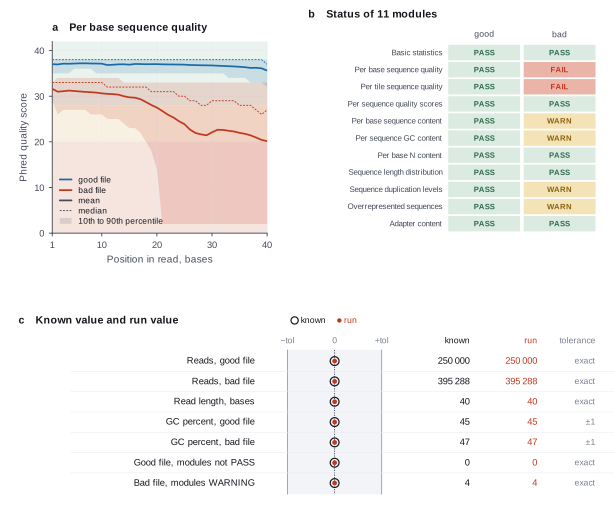
The paper
Andrews S. FastQC: a quality control tool for high throughput sequence data. Babraham Bioinformatics, software documentation (2010). https://www.bioinformatics.babraham.ac.uk/projects/fastqc/
Related sources:
- FastQC example report for the bad example file. The source of the numbers for that file. link
- FastQC example report for the good example file. The source of the numbers for that file. link
What it measured
FastQC checks raw reads from a high-throughput sequencing run before any analysis. It runs 11 modules, and each module gives PASS, WARNING or FAIL. The project page gives two example files from an Illumina run, a good one and a bad one, with the report for each. The reports show what a clean file and a problem file look like. FastQC has no journal paper, so the example reports are the reference.
Data
FastQC project page, the two example read files. Size: 102.7 MB in two FASTQ files with a .txt extension: 39.5 MB with 250,000 reads and 63.2 MB with 395,288 reads..
License: FastQC is GPL v3 or later (GNU General Public License). The page states no license for the example files. The page states no human identifiers.
The instruction
A script sent this message as the scientist. The file paths point to the fetched data.
The same request in the words of the paper's method:
Here are two sequencing read files. Check their quality and tell me if either has a problem. How many reads does each file have, and what is the read length? Which file would you not trust, and why?
Basis: The example reports on the FastQC project page. Each report is the FastQC output for one of the two example files.
Results
Match: a number in the session record is inside the tolerance of the known value. In the final answer: the model also stated the value in its final answer. For a Claude model, each cell shows the run that this page shows. If the three runs differ, the cell also says in how many runs the value matches.
| Value | Known value | Tolerance | Opus | Sonnet | Haiku | qwen3:8b |
|---|---|---|---|---|---|---|
good_total_sequencesGood file total sequencesSource of the known valuePrinted in the official tutorialExample report for the good file, Basic Statistics table. It gives 250000 sequences. | 250000 | exact | 250000 matchIn the final answer: yes (250000)Log: n1 run_fastqc metrics.total_sequences, entry 34; the final answer, entry 108 | 250000 matchIn the final answer: yes (250000)Log: n1 run_fastqc metrics.total_sequences, entry 19; the final answer, entry 76 | 250000 matchIn the final answer: yes (250000)Log: n1 run_fastqc metrics.total_sequences, entry 23; the final answer, entry 100 | 250000 matchIn the final answer: yes (250000)Log: n1 run_fastqc metrics.total_sequences, entry 9; the final answer, entry 25 |
bad_total_sequencesBad file total sequencesSource of the known valuePrinted in the official tutorialExample report for the bad file, Basic Statistics table. It gives 395288 sequences. | 395288 | exact | 395288 matchIn the final answer: yes (395288)Log: n2 run_fastqc metrics.total_sequences, entry 37; the final answer, entry 108 | 395288 matchIn the final answer: yes (395288)Log: n2 run_fastqc metrics.total_sequences, entry 23; the final answer, entry 76 | 395288 matchIn the final answer: yes (395288)Log: n2 run_fastqc metrics.total_sequences, entry 26; the final answer, entry 100 | 395288 matchIn the final answer: yes (395288)Log: n2 run_fastqc metrics.total_sequences, entry 15; the final answer, entry 25 |
sequence_lengthSequence length, both filesSource of the known valuePrinted in the official tutorialBasic Statistics table of both example reports. Both give a length of 40. | 40 | exact | 40 matchIn the final answer: yes (40)Log: n1 run_fastqc metrics.sequence_length, entry 34; the final answer, entry 108 | 40 matchIn the final answer: yes (40)Log: n1 run_fastqc metrics.sequence_length, entry 19; the final answer, entry 76 | 40 matchIn the final answer: yes (40)Log: n1 run_fastqc metrics.sequence_length, entry 23; the final answer, entry 100 | 40 matchIn the final answer: yes (40)Log: n1 run_fastqc metrics.sequence_length, entry 9; the final answer, entry 25 |
good_gc_percentGood file %GCSource of the known valuePrinted in the official tutorialExample report for the good file, Basic Statistics table. It gives a GC content of 45%. | 45 | ± 1 | 45 matchNot asked in the questionLog: n1 run_fastqc metrics.gc_percent, entry 34 | 45 matchNot asked in the questionLog: n1 run_fastqc metrics.gc_percent, entry 19 | 45 matchNot asked in the questionLog: n1 run_fastqc metrics.gc_percent, entry 23 | 45 matchNot asked in the questionLog: n1 run_fastqc metrics.gc_percent, entry 9 |
bad_gc_percentBad file %GCSource of the known valuePrinted in the official tutorialExample report for the bad file, Basic Statistics table. It gives a GC content of 47%. | 47 | ± 1 | 47 matchNot asked in the questionLog: n2 run_fastqc metrics.gc_percent, entry 37 | 47 matchNot asked in the questionLog: n2 run_fastqc metrics.gc_percent, entry 23 | 47 matchNot asked in the questionLog: n2 run_fastqc metrics.gc_percent, entry 26 | 47 matchNot asked in the questionLog: n2 run_fastqc metrics.gc_percent, entry 15 |
good_modules_not_passGood file modules not PASSSource of the known valuePrinted in the official tutorialSummary of the example report for the good file. All 11 modules give PASS. | 0 | exact | 0 matchNot asked in the questionLog: n1 run_fastqc metrics.n_warn, entry 34 | 0 matchNot asked in the questionLog: n1 run_fastqc metrics.n_warn, entry 19 | 0 matchNot asked in the questionLog: n1 run_fastqc metrics.n_warn, entry 23 | 0 matchNot asked in the questionLog: n1 run_fastqc metrics.n_warn, entry 9 |
bad_modules_warningBad file modules with WARNINGSource of the known valuePrinted in the official tutorialSummary of the example report for the bad file. Four modules give WARNING: per base sequence content, per sequence GC content, sequence duplication levels and overrepresented sequences. Two modules give FAIL. | 4 | exact | 4 matchNot asked in the questionLog: n2 run_fastqc metrics.n_warn, entry 37 | 4 matchNot asked in the questionLog: n2 run_fastqc metrics.n_warn, entry 23 | 4 matchNot asked in the questionLog: n2 run_fastqc metrics.n_warn, entry 26 | 4 matchNot asked in the questionLog: n2 run_fastqc metrics.n_warn, entry 15 |
Session records
Session record, Opus, run 3 of 3
Every message, decision, step and result of this run, one JSON object for each log entry.
Session record, Sonnet, run 3 of 3
Every message, decision, step and result of this run, one JSON object for each log entry.
Session record, Haiku, run 3 of 3
Every message, decision, step and result of this run, one JSON object for each log entry.
Session record, qwen3:8b
Every message, decision, step and result of this run, one JSON object for each log entry.
Opus · claude-opus-5-5 · run 3 of 3 shown 7 of 7 values match, 3 of 3 correct in the final answer
The session
This is the session as the scientist sees it, in order. Decision cards show the answer that the script gave and where that answer comes from. Each step shows the program, its version, the input file hash and the outputs. Click a line to see more.
setup The decision record starts with these values. A script set them before the first message, from the answers that we wrote before the run.
- Quality score encoding: phred64Source in the tutorial or test suite: Both example reports give the encoding as Illumina 1.5. That encoding uses Phred quality scores with an offset of 64. FastQC finds the encoding from the file.
- What to do with a module that fails: decide_laterSource in the tutorial or test suite: Not in the documentation. FastQC only reports. Trimming or exclusion of reads is a separate decision for the scientist.
harness note A note from the harness to the model. The scientist did not write it.
- Setup values:
Method:
- Quality score encoding (encoding): phred64
- What to do with a file that has a FAIL module (action_on_fail): decide_later
The harness fills these values into your tool calls automatically. If you give a different value, the harness logs a deviation and shows it to the scientist.
- Mode is now watch: you run the steps.
Model thinking, summary: I should load the relevant skills first since they fit this task.
Model
I start by reading the two skills for this task. They give the steps to check read quality and the quality encoding.
check-read-quality.choose-quality-encoding.Model thinking, summary: The setup mentions phred64 encoding, but I want to verify the files actually use that encoding by checking the quality characters directly. I'll read the file heads first, then run fastqc on each with phred64 specified, comparing against auto-detection to confirm.
Model
The setup value for the encoding is phred64. Before I trust it, I look at the quality characters in each file.
plan The model updates its plan.
- doing Look at the quality characters in each file to check the encoding
- todo Run FastQC on good_sequence_short.txt with the chosen encoding
- todo Run FastQC on bad_sequence.txt with the chosen encoding
- todo Compare the result with the auto encoding if the characters do not fit phred64
- todo Report reads, read length, GC, encoding and WARN or FAIL modules for each file
read_file.Result of read_file: Read 1200 of 39531122 bytes from {data}/andrews-fastqc/good_sequence_short.txt.
@HWUSI-EAS493_0003:2:1:999:20161#0/1
NCAATAAAAAGGCTACAATCAATACAATCTGATTAAAGTC
+HWUSI-EAS493_0003:2:1:999:20161#0/1
BTRQQYVRLLddddddddddddda]aYaaadddddaa^aZ
@HWUSI-EAS493_0003:2:1:999:12623#0/1
NAAAACAGACACACACTCGGGGTCCGGAAGCTTCGTCAAA
+HWUSI-EAS493_0003:2:1:999:12623#0/1
BTMJKTMMUU[_[__`_`^`^]____^__X`_`^_``S^^
@HWUSI-EAS493_0003:2:1:999:13668#0/1
NAGCACTGTGACACCTCCACTTAATGACTTATCTCCTAGA
+HWUSI-EAS493_0003:2:1:999:13668#0/1
BUUTTXWYXW[^V^^````_```^``_`____`^```^``
@HWUSI-EAS493_0003:2:1:999:11796#0/1
NAAGAGAAAACACCTATTTGTCCTGCTAGAAAAACAAGTG
+HWUSI-EAS493_0003:2:1:999:11796#0/1
BQQQLXUXTRdadda[_``\ddddddddd^dadddSSSaa
@HWUSI-EAS493_0003:2:1:999:3170#0/1
NGCCAAACCCATTTGAACGACCACAGAGAGGAAGGCCAAA
+HWUSI-EAS493_0003:2:1:999:3170#0/1
BIIIINNNOJ^____Z[^`^_[___^__[[\[S\X\\\\[
@HWUSI-EAS493_0003:2:1:999:11376#0/1
NATGACCCACCCTCTTCATCCAGAGTGAAGTCCGTAAAGC
+HWUSI-EAS493_0003:2:1:999:11376#0/1
BQVQQZZ[YVddddd]`^^```^V_]]]]]_____][[]]
@HWUSI-EAS493_0003:2:1:999:10663#0/1
NCTTTATTGTACATATAGACCCCAGAGTTCAGGGCAGGTA
+HWUSI-EAS493_0003:2:1:999:10663#0/1
BMMMIPMJJP```^__`__```_`^BBBBBBBBBBBBBBB
@HWUSI-EAS493_0003:2:1:999:19154#0/1
NCAGCTGGAAAAGTGTGCTCAGGACCTGGGAAGCACCTCT
+HWUSI-EAS493_0003:2:1:999:19154
read_file.Result of read_file: Read 1200 of 63211912 bytes from {data}/andrews-fastqc/bad_sequence.txt.
@HWUSI-EAS611_100311:1:1:8:1729#0/1
GATGTTGATGGAACTGACCAAACNTNNNNNGGCCAGTTTT
+HWUSI-EAS611_100311:1:1:8:1729#0/1
a]aa_a_\^`X[]]]^___BBBBBBBBBBBBBBBBBBBBB
@HWUSI-EAS611_100311:1:1:8:1283#0/1
ATTGCTGCCGTCATTGCTTATTANGNNNNNCCCGTCAACA
+HWUSI-EAS611_100311:1:1:8:1283#0/1
a]aa^`\[]a`X``aaaa`_aBBBBBBBBBBBBBBBBBBB
@HWUSI-EAS611_100311:1:1:8:1510#0/1
CCAGCTTGGTAAGTTGGATTAAGNANNNNNTGGACAGATT
+HWUSI-EAS611_100311:1:1:8:1510#0/1
aa`babbaaYaaaaaababbbb]D\DDDDDJX`a]`a^_b
@HWUSI-EAS611_100311:1:1:8:1926#0/1
GTGTTTTCCATAATAGACGCAACNCNNNNNGTAGACTCCT
+HWUSI-EAS611_100311:1:1:8:1926#0/1
`[a^a`a]][a`_a`[]``WZ`WDXDDDDDXR^[[Z^\UX
@HWUSI-EAS611_100311:1:1:8:136#0/1
CATGGAAGGCGCTGAATTTACGGNANNNNNTATTAATGGC
+HWUSI-EAS611_100311:1:1:8:136#0/1
``bbabb`abbbbbabbbb`aa^D[DDDDD^abbaab`\U
@HWUSI-EAS611_100311:1:1:8:1426#0/1
ATCTCTTCCAAGAGCTTGATGCGNTNNNNNATCTGCTTAT
+HWUSI-EAS611_100311:1:1:8:1426#0/1
aab_``aaaa`Y^aaaaa_aaa[DPDDDDDX^_XTZ[^S]
@HWUSI-EAS611_100311:1:1:8:487#0/1
GACATTATGGGTCTGCAAGCTGCNTNNNNNAATTTGCATA
+HWUSI-EAS611_100311:1:1:8:487#0/1
a`a`aab`X``\a[`]]]`^ZVUDZDDDDDT\__`\]\\`
@HWUSI-EAS611_100311:1:1:8:332#0/1
AGCTTGCAAAATACGTGGCCTTANGNNNNNAGTATGCCCA
+HWUSI-EAS611_100311:1:1:8:332#0/1
Y_`bXU\^[^^baa]
Model thinking, summary: The quality values fall in the 64-104 range, which points to Phred+64 encoding like Illumina 1.5. I'll proceed with phred64 for this analysis.
Model thinking, summary: The quality characters span uppercase, lowercase, and symbols like ], ^, and `, ranging from "B" to "d" — consistent with Illumina 1.3–1.7 (Phred+64) encoding, matching the phred64 setup. I'll run FastQC on each file using phred64 next.
note Both files use quality characters from "B" to "d" in the first reads. Many reads end in runs of "B" (Illumina 1.5 read-segment quality indicator). This fits Phred+64 encoding and the setup value phred64. bad_sequence.txt has many N bases near cycles 24 to 30 in the first reads.
run_fastqc (adapter fastqc).step n1 run_fastqc adapter fastqc 0.1.2, FastQC 0.13.0
250000 reads of length 40. 11 PASS, 0 WARN, 0 FAIL.
Decisions applied: Quality score encoding = phred64.
Input file: {data}/andrews-fastqc/good_sequence_short.txt SHA-256 56d49e766f2f.
Outputs: fastqc.log (e3b0c44298fc), good_sequence_short_fastqc.html (0b07422b1d44), good_sequence_short_fastqc.zip (ea907c620479), error.png (b9c7d86bf2dd), fastqc_icon.png (e63253011f67), tick.png (e9ed21a3f0e4), warning.png (24e92cafbeb0), adapter_content.png (4d2a7960f4b3), adapter_content.svg (4ccc06886ca2), duplication_levels.png (cc2b3b82b001), duplication_levels.svg (f0d578574842), per_base_n_content.png (5e6f8aee4812), per_base_n_content.svg (b8f9aaa83685), per_base_quality.png (92d300eb7b2d), per_base_quality.svg (8019a71e1240), per_base_sequence_content.png (59f96206d73f), per_base_sequence_content.svg (9665721cbe9b), per_sequence_gc_content.png (9ce88b427acd), per_sequence_gc_content.svg (dd575a96a8c2), per_sequence_quality.png (98e42628646d), per_sequence_quality.svg (52e215f579fa), per_tile_quality.png (6c811ad94097), per_tile_quality.svg (cf8389ba7c4c), sequence_length_distribution.png (9c96e93f04cc), sequence_length_distribution.svg (c6d50861834a), fastqc.fo (a1887a931de0), fastqc_data.txt (0908e6471b79), fastqc_report.html (0b07422b1d44), summary.txt (a9dbec8f9c1a).
Arguments
| path | {data}/andrews-fastqc/good_sequence_short.txt |
| encoding | phred64 |
Tool output
data_file={work}/run_fastqc-1/report/good_sequence_short_fastqc/fastqc_data.txt
html_report={work}/run_fastqc-1/report/good_sequence_short_fastqc.html
module_basic_statistics=PASS
filename=good_sequence_short.txt
file_type=Conventional base calls
encoding=Illumina 1.5
total_sequences=250000
total_bases=10 Mbp
sequence_length=40
mean_length=40
median_length=40
gc_percent=45
module_per_base_sequence_quality=PASS
module_per_tile_sequence_quality=PASS
module_per_sequence_quality_scores=PASS
module_per_base_sequence_content=PASS
module_per_sequence_gc_content=PASS
module_per_base_n_content=PASS
module_sequence_length_distribution=PASS
module_sequence_duplication_levels=PASS
module_overrepresented_sequences=PASS
module_adapter_content=PASS
n_pass=11
n_warn=0
n_fail=0
fail_modules=none
warn_modules=none
run_fastqc (adapter fastqc).step n2 run_fastqc adapter fastqc 0.1.2, FastQC 0.13.0
395288 reads of length 40. 5 PASS, 4 WARN, 2 FAIL.
Decisions applied: Quality score encoding = phred64.
Input file: {data}/andrews-fastqc/bad_sequence.txt SHA-256 6a13706bf7bf.
Outputs: fastqc.log (e3b0c44298fc), bad_sequence_fastqc.html (5afb979bf848), bad_sequence_fastqc.zip (f5912a6aee69), error.png (b9c7d86bf2dd), fastqc_icon.png (e63253011f67), tick.png (e9ed21a3f0e4), warning.png (24e92cafbeb0), adapter_content.png (236e5fea9f51), adapter_content.svg (3530c4e8f96c), duplication_levels.png (457b031dd3cc), duplication_levels.svg (5472bcbe30c6), per_base_n_content.png (d5d90f5851f0), per_base_n_content.svg (02b9c8384f92), per_base_quality.png (9d47380d0007), per_base_quality.svg (c04130635782), per_base_sequence_content.png (98322a251f0d), per_base_sequence_content.svg (95e7b0097d6c), per_sequence_gc_content.png (f7b3efee2b42), per_sequence_gc_content.svg (9f9c4349defa), per_sequence_quality.png (e034e336f021), per_sequence_quality.svg (57549aba1d53), per_tile_quality.png (21acc1f99ab1), per_tile_quality.svg (de9e6d2ada9e), sequence_length_distribution.png (2f212f6a9dd6), sequence_length_distribution.svg (18d5deaf297c), fastqc.fo (8e420d400f6b), fastqc_data.txt (353552e3b3a1), fastqc_report.html (5afb979bf848), summary.txt (38efb7e96366).
Arguments
| path | {data}/andrews-fastqc/bad_sequence.txt |
| encoding | phred64 |
Tool output
data_file={work}/run_fastqc-2/report/bad_sequence_fastqc/fastqc_data.txt
html_report={work}/run_fastqc-2/report/bad_sequence_fastqc.html
module_basic_statistics=PASS
filename=bad_sequence.txt
file_type=Conventional base calls
encoding=Illumina 1.5
total_sequences=395288
total_bases=15.8 Mbp
sequence_length=40
mean_length=40
median_length=40
gc_percent=47
module_per_base_sequence_quality=FAIL
module_per_tile_sequence_quality=FAIL
module_per_sequence_quality_scores=PASS
module_per_base_sequence_content=WARN
module_per_sequence_gc_content=WARN
module_per_base_n_content=PASS
module_sequence_length_distribution=PASS
module_sequence_duplication_levels=WARN
module_overrepresented_sequences=WARN
module_adapter_content=PASS
n_pass=5
n_warn=4
n_fail=2
fail_modules=Per base sequence quality; Per tile sequence quality
warn_modules=Per base sequence content; Per sequence GC content; Sequence Duplication Levels; Overrepresented sequences
Model thinking, summary: I'm checking whether the "Illumina 1.5" encoding was auto-detected or forced, and comparing against an auto-guess run to confirm. I also want to look at the per-base quality plot for evidence of where scores drop, and verify whether this file is just a subsampled version.
Model thinking, summary: Both runs succeeded, and the reports show "Illumina 1.5" encoding since I explicitly specified phred64 rather than letting FastQC guess. Now I'll run a comparison with auto encoding to see if FastQC's guess matches and whether any statuses change.
compare_options.comparison run n3 run_fastqc adapter fastqc 0.1.2, FastQC 0.13.0
395288 reads of length 40. 6 PASS, 4 WARN, 1 FAIL.
Input file: {data}/andrews-fastqc/bad_sequence.txt SHA-256 6a13706bf7bf.
Outputs: fastqc.log (21e4c758b213), bad_sequence_fastqc.html (703e1cd9a5ab), bad_sequence_fastqc.zip (d36ebe634e61), error.png (b9c7d86bf2dd), fastqc_icon.png (e63253011f67), tick.png (e9ed21a3f0e4), warning.png (24e92cafbeb0), adapter_content.png (236e5fea9f51), adapter_content.svg (3530c4e8f96c), duplication_levels.png (457b031dd3cc), duplication_levels.svg (5472bcbe30c6), per_base_n_content.png (d5d90f5851f0), per_base_n_content.svg (02b9c8384f92), per_base_quality.png (1314c2a4e450), per_base_quality.svg (ee35d37fbc67), per_base_sequence_content.png (98322a251f0d), per_base_sequence_content.svg (95e7b0097d6c), per_sequence_gc_content.png (f7b3efee2b42), per_sequence_gc_content.svg (9f9c4349defa), per_sequence_quality.png (38c3ff13ea43), per_sequence_quality.svg (44a96ea9f8a1), per_tile_quality.png (21acc1f99ab1), per_tile_quality.svg (de9e6d2ada9e), sequence_length_distribution.png (2f212f6a9dd6), sequence_length_distribution.svg (18d5deaf297c), fastqc.fo (f687b696468f), fastqc_data.txt (bfab5b5d18df), fastqc_report.html (703e1cd9a5ab), summary.txt (47c843f77b62).
Arguments
| path | {data}/andrews-fastqc/bad_sequence.txt |
| encoding | auto |
Tool output
data_file={work}/run_fastqc-3/report/bad_sequence_fastqc/fastqc_data.txt
html_report={work}/run_fastqc-3/report/bad_sequence_fastqc.html
module_basic_statistics=PASS
filename=bad_sequence.txt
file_type=Conventional base calls
encoding=Sanger / Illumina 1.9
total_sequences=395288
total_bases=15.8 Mbp
sequence_length=40
mean_length=40
median_length=40
gc_percent=47
module_per_base_sequence_quality=PASS
module_per_tile_sequence_quality=FAIL
module_per_sequence_quality_scores=PASS
module_per_base_sequence_content=WARN
module_per_sequence_gc_content=WARN
module_per_base_n_content=PASS
module_sequence_length_distribution=PASS
module_sequence_duplication_levels=WARN
module_overrepresented_sequences=WARN
module_adapter_content=PASS
n_pass=6
n_warn=4
n_fail=1
fail_modules=Per tile sequence quality
warn_modules=Per base sequence content; Per sequence GC content; Sequence Duplication Levels; Overrepresented sequences
log_note=Using Phred32 encoding your lowest quality is 34 could this file be Phred64 encoded?
comparison Comparison runs for Quality score encoding. The record keeps the scientist's choice.
Quality score encoding  total_sequences  sequence_length  mean_length  median_length  gc_percent  n_pass  n_warn  n_fail  Result
auto                    395288           40               40           40             47          6       4       1       ok
Result of compare_options: Compared 1 values of Quality score encoding as comparison runs of the last step, run_fastqc. Only that step was repeated. To compare another step, run it again ...
Compared 1 values of Quality score encoding as comparison runs of the last step, run_fastqc. Only that step was repeated. To compare another step, run it again first. The record still says "phred64".
Quality score encoding  total_sequences  sequence_length  mean_length  median_length  gc_percent  n_pass  n_warn  n_fail  Result
auto                    395288           40               40           40             47          6       4       1       ok
Model thinking, summary: The status counts between auto and phred64 modes don't match up, so I need to figure out which module changed and what encoding was guessed. I should check the work folder for the comparison run outputs to pin down the actual deviation.
Model thinking, summary: Auto comparison on bad_sequence.txt yields 6 PASS/4 WARN/1 FAIL, while phred64 yields 5 PASS/4 WARN/2 FAIL, showing one module differs. I'll check the comparison report to identify the changed module and which encoding FastQC detected.
list_dir.Result of list_dir: 6 entries in {work}.
- ._run_fastqc-1  4096
- ._run_fastqc-2  4096
- ._run_fastqc-3  4096
d run_fastqc-1
d run_fastqc-2
d run_fastqc-3
read_modules (adapter fastqc).comparison run n4 read_modules adapter fastqc 0.1.2, FastQC 0.13.0
11 modules listed.
Arguments
| data_file | {work}/run_fastqc-3/report/bad_sequence_fastqc/fastqc_data.txt |
Tool output
module,status
Basic Statistics,PASS
Per base sequence quality,PASS
Per tile sequence quality,FAIL
Per sequence quality scores,PASS
Per base sequence content,WARN
Per sequence GC content,WARN
Per base N content,PASS
Sequence Length Distribution,PASS
Sequence Duplication Levels,WARN
Overrepresented sequences,WARN
Adapter Content,PASS
read_file.Result of read_file: Read 4000 of 136144 bytes from {work}/run_fastqc-3/report/bad_sequence_fastqc/fastqc_data.txt.
##FastQC	0.13.0
>>Basic Statistics	pass
#Measure	Value
Filename	bad_sequence.txt
File type	Conventional base calls
Encoding	Sanger / Illumina 1.9
Total Sequences	395288
Total Bases	15.8 Mbp
Sequence length	40
Mean Length	40
Median Length	40
%GC	47
>>END_MODULE
>>Per base sequence quality	pass
#Base	Mean	Median	Lower Quartile	Upper Quartile	10th Percentile	90th Percentile
1	62.6106712068163	64.0	63.0	64.0	60.0	64.0
2	61.98824907409281	64.0	62.0	64.0	57.0	65.0
3	62.09275768553561	64.0	62.0	64.0	58.0	65.0
4	62.2292353929287	64.0	62.0	64.0	58.0	65.0
5	62.137433972192426	64.0	62.0	64.0	58.0	65.0
6	62.04162534658275	64.0	62.0	64.0	58.0	65.0
7	61.94712209831819	64.0	62.0	64.0	58.0	65.0
8	61.88066675436644	64.0	62.0	64.0	57.0	65.0
9	61.77974793062273	64.0	62.0	64.0	57.0	65.0
10	61.62082076865475	64.0	62.0	64.0	57.0	65.0
11	61.51441480641962	63.0	61.0	64.0	56.0	65.0
12	61.45449899819878	63.0	61.0	64.0	56.0	65.0
13	61.34481694359555	63.0	61.0	64.0	56.0	65.0
14	60.9954463580984	63.0	61.0	64.0	55.0	64.0
15	60.74949403978871	63.0	61.0	64.0	54.0	64.0
16	60.68013701402522	63.0	61.0	64.0	54.0	64.0
17	60.35002327416972	63.0	60.0	64.0	53.0	64.0
18	59.72653862500253	63.0	59.0	64.0	51.0	64.0
19	59.06410768857137	62.0	59.0	64.0	49.0	64.0
20	58.50230211896137	62.0	58.0	64.0	45.0	64.0
21	57.740644795693264	62.0	57.0	64.0	33.0	64.0
22	56.93953522494991	62.0	56.0	64.0	33.0	64.0
23	56.33044261399284	62.0	55.0	64.0	33.0	64.0
24	55.52377001072636	61.0	53.0	63.0	33.0	64.0
25	54.87053237133432	61.0	51.0	63.0	33.0	64.0
26	53.68923164882314	60.0	45.0	63.0	33.0	64.0
27	52.93644886766105	60.0	35.0	63.0	33.0	64.0
28	52.63794246220477	59.0	35.0	63.0	33.0	64.0
29	52.43163212644958	59.0	35.0	63.0	33.0	64.0
30	53.083197567343305	60.0	35.0	63.0	33.0	64.0
31	53.64848161340592	60.0	45.0	63.0	33.0	64.0
32	53.61258373641497	60.0	44.0	63.0	33.0	64.0
33	53.42868490821882	60.0	43.0	63.0	33.0	64.0
34	53.26709892534051	60.0	41.0	63.0	33.0	64.0
35	52.970133168727614	59.0	38.0	63.0	33.0	64.0
36	52.75068051648418	59.0	33.0	62.0	33.0	64.0
37	52.419807836311755	59.0	33.0	62.0	33.0	64.0
38	51.94544737001882	58.0	33.0	62.0	33.0	64.0
39	51.4324264839813	57.0	33.0	62.0	33.0	64.0
40	51.15008297747465	58.0	33.0	62.0	33.0	64.0
>>END_MODULE
>>Per tile sequence quality	fail
#Tile	Base	Mean
1	1	-1.0281278162191896
1	2	-1.1754453583201965
1	3	-1.6423171389097462
1	4	-1.3501076407981927
1	5	-1.5082380257045145
1	6	-1.411032335154573
1	7	-1.4598955545107302
1	8	-1.4450080002335852
1	9	-1.5311065461153746
1	10	-1.6978779713035124
1	11	-1.541986683025364
1	12	-1.6428199463507411
1	13	-1.4543992506052987
1	14	-1.522267611415721
1	15	-1.346472878373433
1	16	-1.7169054060624518
1	17	-1.7068061987059409
1	18	-1.5077315855932625
1	19	-1.3986015836569052
1	20	-1.2344385769950108
1	21	-1.4193792085461396
1	22	-1.2347556900553371
1	23	-1.3461692352018915
1	24	-1.298601706342545
1	25	-1.1437696580929426
1	26	-1.618292853930832
1	27	-2.0735428521424737
1	28	-1.9371718662571098
1	29	-1.6693284659947523
1	30	-1.22446641696569
... (1000 more characters in the session record)
read_file.Result of read_file: Read 4000 of 136054 bytes from {work}/run_fastqc-2/report/bad_sequence_fastqc/fastqc_data.txt.
##FastQC	0.13.0
>>Basic Statistics	pass
#Measure	Value
Filename	bad_sequence.txt
File type	Conventional base calls
Encoding	Illumina 1.5
Total Sequences	395288
Total Bases	15.8 Mbp
Sequence length	40
Mean Length	40
Median Length	40
%GC	47
>>END_MODULE
>>Per base sequence quality	fail
#Base	Mean	Median	Lower Quartile	Upper Quartile	10th Percentile	90th Percentile
1	31.610671206816296	33.0	32.0	33.0	29.0	33.0
2	30.988249074092813	33.0	31.0	33.0	26.0	34.0
3	31.09275768553561	33.0	31.0	33.0	27.0	34.0
4	31.2292353929287	33.0	31.0	33.0	27.0	34.0
5	31.137433972192426	33.0	31.0	33.0	27.0	34.0
6	31.041625346582745	33.0	31.0	33.0	27.0	34.0
7	30.94712209831819	33.0	31.0	33.0	27.0	34.0
8	30.880666754366437	33.0	31.0	33.0	26.0	34.0
9	30.779747930622737	33.0	31.0	33.0	26.0	34.0
10	30.620820768654752	33.0	31.0	33.0	26.0	34.0
11	30.514414806419623	32.0	30.0	33.0	25.0	34.0
12	30.454498998198783	32.0	30.0	33.0	25.0	34.0
13	30.344816943595557	32.0	30.0	33.0	25.0	34.0
14	29.9954463580984	32.0	30.0	33.0	24.0	33.0
15	29.74949403978871	32.0	30.0	33.0	23.0	33.0
16	29.680137014025217	32.0	30.0	33.0	23.0	33.0
17	29.35002327416972	32.0	29.0	33.0	22.0	33.0
18	28.72653862500253	32.0	28.0	33.0	20.0	33.0
19	28.064107688571372	31.0	28.0	33.0	18.0	33.0
20	27.502302118961364	31.0	27.0	33.0	14.0	33.0
21	26.740644795693267	31.0	26.0	33.0	2.0	33.0
22	25.93953522494991	31.0	25.0	33.0	2.0	33.0
23	25.330442613992837	31.0	24.0	33.0	2.0	33.0
24	24.523770010726356	30.0	22.0	32.0	2.0	33.0
25	23.870532371334317	30.0	20.0	32.0	2.0	33.0
26	22.689231648823135	29.0	14.0	32.0	2.0	33.0
27	21.936448867661046	29.0	4.0	32.0	2.0	33.0
28	21.637942462204773	28.0	4.0	32.0	2.0	33.0
29	21.431632126449575	28.0	4.0	32.0	2.0	33.0
30	22.083197567343305	29.0	4.0	32.0	2.0	33.0
31	22.64848161340592	29.0	14.0	32.0	2.0	33.0
32	22.61258373641497	29.0	13.0	32.0	2.0	33.0
33	22.428684908218816	29.0	12.0	32.0	2.0	33.0
34	22.267098925340512	29.0	10.0	32.0	2.0	33.0
35	21.97013316872761	28.0	7.0	32.0	2.0	33.0
36	21.750680516484184	28.0	2.0	31.0	2.0	33.0
37	21.41980783631175	28.0	2.0	31.0	2.0	33.0
38	20.945447370018822	27.0	2.0	31.0	2.0	33.0
39	20.4324264839813	26.0	2.0	31.0	2.0	33.0
40	20.15008297747465	27.0	2.0	31.0	2.0	33.0
>>END_MODULE
>>Per tile sequence quality	fail
#Tile	Base	Mean
1	1	-1.0281278162192038
1	2	-1.1754453583201787
1	3	-1.6423171389097497
1	4	-1.3501076407982104
1	5	-1.508238025704511
1	6	-1.4110323351546086
1	7	-1.4598955545107088
1	8	-1.4450080002335852
1	9	-1.531106546115403
1	10	-1.6978779713035301
1	11	-1.5419866830253852
1	12	-1.6428199463507163
1	13	-1.4543992506052987
1	14	-1.522267611415721
1	15	-1.3464728783734508
1	16	-1.7169054060624447
1	17	-1.7068061987059373
1	18	-1.5077315855932554
1	19	-1.3986015836569123
1	20	-1.2344385769950321
1	21	-1.419379208546129
1	22	-1.2347556900553727
1	23	-1.346169235201895
1	24	-1.2986017063425628
1	25	-1.1437696580929355
1	26	-1.618292853930825
1	27	-2.073542852142463
1	28	-1.9371718662570956
1	29	-1.66932846599477
1	30	-1.2244664169656865
1	31	-1.293218984
... (1000 more characters in the session record)
Model thinking, summary: The comparison reveals auto mode misdetects bad_sequence.txt as Phred33, inflating quality scores by 31 and flipping "Per base sequence quality" from FAIL to PASS incorrectly—phred64 gives the correct result. I'll record this finding and save a summary table.
note Encoding check on bad_sequence.txt: with auto, FastQC guessed "Sanger / Illumina 1.9". Quality values then go up by 31, and Per base sequence quality changes from FAIL to PASS. The quality characters (B to d) fit Phred+64, so the phred64 run (Illumina 1.5) is the valid one. The auto run is a comparison only.
The model runs run_script.
from ga_api import save_table
rows = [
 {"file":"good_sequence_short.txt","encoding_setting":"phred64","encoding_line":"Illumina 1.5","total_reads":250000,"read_length_bp":40,"gc_percent":45,"n_pass":11,"n_warn":0,"n_fail":0,"fail_modules":"none","warn_modules":"none","use":"result"},
 {"file":"bad_sequence.txt","encoding_setting":"phred64","encoding_line":"Illumina 1.5","total_reads":395288,"read_length_bp":40,"gc_percent":47,"n_pass":5,"n_warn":4,"n_fail":2,"fail_modules":"Per base sequence quality; Per tile sequence quality","warn_modules":"Per base sequence content; Per sequence GC content; Sequence Duplication Levels; Overrepresented sequences","use":"result"},
 {"file":"bad_sequence.txt","encoding_setting":"auto","encoding_line":"Sanger / Illumina 1.9 (wrong guess)","total_reads":395288,"read_length_bp":40,"gc_percent":47,"n_pass":6,"n_warn":4,"n_fail":1,"fail_modules":"Per tile sequence quality","warn_modules":"Per base sequence content; Per sequence GC content; Sequence Duplication Levels; Overrepresented sequences","use":"comparison only"},
]
save_table("fastqc_summary", rows)
print("saved")run_script. In this validation, the harness lets the model use every tool and does not ask the scientist.step n5 run_script
The script ran in {work} and wrote 1 new file(s) to {work}.
Outputs: fastqc_summary.csv (84ed4da497c6).
Arguments
| purpose | Save one summary table of the FastQC results for the two files. |
| does | Writes one row for each file and one row for the auto comparison run. Each row has reads, read length, GC, encoding and the WARN and FAIL modules. Saves the table as fastqc_summary.csv. |
| code | from ga_api import save_table
rows = [
{"file":"good_sequence_short.txt","encoding_setting":"phred64","encoding_line":"Illumina 1.5","total_reads":250000,"read_length_bp":40,"gc_percent":45,"n_pass":11,"n_warn":0,"n_fail":0,"fail_modules":"none","warn_modules":"none","use":"result"},
{"file":"bad_sequence.txt","encoding_setting":"phred64","encoding_line":"Illumina 1.5","total_reads":395288,"read ... |
Tool output
saved
plan The model updates its plan.
- done Look at the quality characters in each file to check the encoding
- done Run FastQC on good_sequence_short.txt with the chosen encoding
- done Run FastQC on bad_sequence.txt with the chosen encoding
- done Compare the result with the auto encoding if the characters do not fit phred64
- done Report reads, read length, GC, encoding and WARN or FAIL modules for each file
Model thinking, summary: I should write the final answer now, being careful not to assert trimming was necessary or claim a definitive cause, and noting that the subsample size remains unknown.
Model Answer draft 1. The claim check and the review read it.
Of the two files, I would not trust bad_sequence.txt. Its quality goes down along the read, and FastQC fails two quality modules. good_sequence_short.txt passes all 11 modules.
Results for each file
I ran FastQC once on each file with your setup encoding, phred64. Each file has its own report.
good_sequence_short.txt
- Reads: 250000
- Read length: 40 bp
- GC: 45 %
- Encoding: "Illumina 1.5". I set this with phred64, so FastQC did not guess it.
- Module statuses: 11 PASS, 0 WARN, 0 FAIL.
bad_sequence.txt
- Reads: 395288
- Read length: 40 bp
- GC: 47 %
- Encoding: "Illumina 1.5". I set this with phred64, so FastQC did not guess it.
- FAIL: Per base sequence quality and Per tile sequence quality.
- WARN: Per base sequence content, Per sequence GC content, Sequence Duplication Levels and Overrepresented sequences.
- All other modules are PASS.
Why I would not trust bad_sequence.txt
In the per-base quality table:
- The mean quality is 31.6 at base 1 and 20.2 at base 40.
- From base 21, the lowest 10 % of reads have quality 2.
- At bases 27 to 30, the lower quartile is 4. From base 36 to base 40 it is 2.
The Per tile sequence quality module also fails, so some tiles are worse than the mean of the run. The report does not show what caused these problems. I also do not say if the file needs trimming or if you must leave it out. That is your decision.
The encoding guess hides a FAIL
- The quality characters in both files go from "B" to "d". This fits Phred+64 (Illumina 1.3 to 1.7), so phred64 is correct.
- As a check, I ran bad_sequence.txt again with the auto setting. FastQC guessed "Sanger / Illumina 1.9", which is wrong.
- That wrong guess adds 31 to each quality score. Per base sequence quality then changes from FAIL to PASS, and the result is 6 PASS, 4 WARN, 1 FAIL.
- Use the phred64 result. The auto run is only a comparison.
What is uncertain
- A FastQC status is a rule of thumb, not a verdict on the data. A PASS does not prove that the reads are good.
- WARN for base content, duplication and overrepresented sequences can be normal for some library types. The library type of these files is not known.
- I do not know if either file is a subsample of a larger run. The name "short" suggests this, but the report does not show it.
- I did not do the auto comparison for good_sequence_short.txt. The comparison tool only repeated the last run.
What waits for you
- Decide what to do with bad_sequence.txt. Your setup for files with a FAIL module is "decide_later".
- Tell me the library type, so I can read the WARN modules correctly.
- Tell me if the files are subsamples.
Files are in the session folder:
- fastqc_summary.csv
- run_fastqc-1/ (good_sequence_short.txt, phred64)
- run_fastqc-2/ (bad_sequence.txt, phred64)
- run_fastqc-3/ (bad_sequence.txt, auto comparison only)
To repeat a run by hand, use the command in the "manual_route" line of each result.
review The review sent the answer back to the model before the scientist saw it.
- The answer uses 64, 1.9 from a comparison run of another option (encoding), not from the setting that was chosen. Use the result of the chosen setting, or say clearly that the number is from the comparison.
- 2 numbers in the answer match no logged tool result: 1.3, 1.7. Run the tool that measures each number, or remove the number, or say how you derived it from logged results.
Fix these problems. Then give the answer again.
Model
I check the shift between the two runs with a calculation so that I do not give a number that a tool did not report.
The model runs calculate.
{"items":[{"name":"shift_base1_mean_auto_minus_phred64","expression":"62.6106712068163 - 31.610671206816296"},{"name":"shift_base40_mean_auto_minus_phred64","expression":"51.15008297747465 - 20.15008297747465"}],"purpose":"Find how much the auto comparison run moves the mean quality at base 1 and base 40."}step n6 calculate
Calculated 2 values.
Arguments
| items | [{"name":"shift_base1_mean_auto_minus_phred64","expression":"62.6106712068163 - 31.610671206816296"},{"name":"shift_base40_mean_auto_minus_phred64","expression":"51.15008297747465 - 20.15008297747465"}] |
Tool output
shift_base1_mean_auto_minus_phred64 = 62.6106712068163 - 31.610671206816296 = 31
shift_base40_mean_auto_minus_phred64 = 51.15008297747465 - 20.15008297747465 = 31
Model thinking, summary: I should clearly label which numbers come from the comparison run and avoid ambiguous version-like figures, noting that the specific encoding value there only applies to that comparison run.
Model The model writes its answer. The claim check reads it. See the final answer.
The final answer
The model wrote this answer. The harness shows it to the scientist after the review.
Of the two files, I would not trust bad_sequence.txt. Its quality goes down along the read, and FastQC fails two quality modules. good_sequence_short.txt passes all 11 modules.
Results for each file
I ran FastQC once on each file with your setup encoding, phred64. Each file has its own report. All numbers in this section come from these phred64 runs.
good_sequence_short.txt
- Reads: 250000
- Read length: 40 bp
- GC: 45 %
- Encoding: "Illumina 1.5". I set the encoding to phred64, so FastQC did not guess it.
- Module statuses: 11 PASS, 0 WARN, 0 FAIL.
bad_sequence.txt
- Reads: 395288
- Read length: 40 bp
- GC: 47 %
- Encoding: "Illumina 1.5". I set the encoding to phred64, so FastQC did not guess it.
- FAIL: Per base sequence quality and Per tile sequence quality.
- WARN: Per base sequence content, Per sequence GC content, Sequence Duplication Levels and Overrepresented sequences.
- All other modules are PASS.
Why I would not trust bad_sequence.txt
The per-base quality table of the phred64 run shows:
- The mean quality is 31.6 at base 1 and 20.2 at base 40.
- From base 21, the lowest 10 % of reads have quality 2.
- At bases 27 to 30, the lower quartile is 4. From base 36 to base 40 it is 2.
The Per tile sequence quality module also fails, so some tiles are worse than the mean of the run. The report does not show what caused these problems. I also do not say if the file needs trimming or if you must leave it out. That is your decision.
Encoding check (comparison run only)
- In the first reads of both files, the quality characters go from "B" to "d". These are upper case letters, lower case letters and symbols such as "]" and "^". These characters fit phred64 encoding, so your setup value is correct.
- As a check only, I ran bad_sequence.txt again with the auto setting. In that comparison run, FastQC guessed "Sanger / Illumina 1.9", which is the wrong encoding for these files.
- In the comparison run, every mean quality is 31 higher than in the phred64 run. I calculated this at base 1 and at base 40.
- In the comparison run, Per base sequence quality changes from FAIL to PASS. That run gives 6 PASS, 4 WARN and 1 FAIL.
- Do not use the comparison run. All results that I report come from the phred64 run.
What is uncertain
- A FastQC status is a rule of thumb, not a verdict on the data. A PASS does not prove that the reads are good.
- WARN for base content, duplication and overrepresented sequences can be normal for some library types. The library type of these files is not known.
- I do not know if either file is a subsample of a larger run. The name "short" suggests this, but the report does not show it.
- I did not do the auto comparison for good_sequence_short.txt. The comparison tool only repeated the last run.
What waits for you
- Decide what to do with bad_sequence.txt. Your setup for files with a FAIL module is "decide_later".
- Tell me the library type, so I can read the WARN modules correctly.
- Tell me if the files are subsamples.
Files are in the session folder:
- fastqc_summary.csv
- run_fastqc-1/ (good_sequence_short.txt, phred64)
- run_fastqc-2/ (bad_sequence.txt, phred64)
- run_fastqc-3/ (bad_sequence.txt, auto comparison only)
To repeat a run by hand, use the command in the "manual_route" line of each result.
Settings and step results that the answer does not mention. The harness adds them.
Step results that the answer does not mention, from the record:
- n5 run_script: The script ran in {work} and wrote 1 new file(s) to {work}.

Settings used, from the decision record: Quality score encoding: phred64.
Checks
Review findings
The review recorded 7 findings. A rule finding comes from a fixed check in the harness. A referee finding comes from a second model that reads the record. The harness shows the findings to the scientist with the final answer. The record does not mark a finding as fixed. Thus a finding from an early review round can apply to a draft that the model corrected later.
| Severity | From | Finding | Shown with the final answer |
|---|---|---|---|
| info | ruletext_style | The answer breaks the text rules (ASD-STE100) in 1 place. Sentence 45 uses the passive voice: "is not known". Use the active voice. | yes |
| warning | referee model | The answer names the FAIL and WARN modules of the phred64 run of bad_sequence.txt. But read_modules ran only on the auto comparison run. The phred64 run gave only counts (2 FAIL, 4 WARN), so the module names come from the comparison run and from inference. read_modules must run on the phred64 report before the answer names its modules. | yes |
| warning | referee model | The answer says that every mean quality in the auto run is 31 higher than in the phred64 run. The calculation covered only base 1 and base 40. The claim must stay limited to the bases that the analyst checked. | yes |
| warning | referee model | The answer gives the encoding line "Illumina 1.5" for good_sequence_short.txt. No step read the fastqc_data.txt of that run, and its metrics do not show the encoding. The encoding line for this file is inferred from the run setting. It is not read from its own report. | yes |
| info | referee model | The analyst ran the auto encoding comparison only on bad_sequence.txt. The answer states this limit correctly. | yes |
| info | referee model | The answer describes the quality characters, for example "B" to "d", "]" and "^". The log does not show the read_file output, so this review cannot confirm these characters. The encoding choice agrees with the setup value phred64. | yes |
| info | referee model | The answer says that statuses are rules of thumb. It says that the subsample status is not known. It leaves the trimming and exclusion decision to the scientist. These parts meet the adapter checks. | yes |
Numbers in the answer
The last claim check read 34 numbers in the answer. 33 numbers match a logged result. 0 numbers have no source in the record.
Numbers that do not match a logged result (1)
- calculated from numbers in the record: The name "short" suggests this, but the report does not show it.
Deviations
The model did not try to change a choice of the scientist.
Failed tool calls
No tool call failed.
Data integrity
Each data file has the same SHA-256 hash now as at the time of the step that read it. Where the download script (fetch.sh) gives a hash, the file also has that hash. The run did not change the data.
| File | SHA-256 | Fetched data | Steps with this hash |
|---|---|---|---|
{data}/andrews-fastqc/good_sequence_short.txt37.7 MB | 56d49e766f2f | same as the hash in the download script (fetch.sh) | n1 |
{data}/andrews-fastqc/bad_sequence.txt60.3 MB | 6a13706bf7bf | same as the hash in the download script (fetch.sh) | n2, n3 |
A SHA-256 hash is a fingerprint of the file contents. If one byte of the file changes, the hash changes. The table shows the first 12 characters.
How to repeat it
Get the data. The script downloads the files and checks their SHA-256 hashes where it lists them.
CUVETTE_DATA={data} bash bench/papers/andrews-fastqc/fetch.shRun the same case with Cuvette. The script gives the same answers from bench/papers/andrews-fastqc/bench.yaml.
cuvette bench papers --papers andrews-fastqc --models claude:claude-opus-5-5
Repeat each step by hand in the program. For each step, the harness records a manual route: the menu path or the code that gives the same result. This list does not include comparison runs.
run_fastqc(step n1)Run: fastqc --extract --outdir <folder> [--phred64] <reads file>. In the FastQC window:
<reads file>
{data}/andrews-fastqc/good_sequence_short.txt- --phred64 =
phred64 - Warning: If you keep the default auto, you get a different result.
The manual route that the harness recorded
/bin/sh {other volume}/tools/overnight/claude-final/catalog/fastqc/scripts/run_fastqc.sh /opt/homebrew/bin/fastqc {data}/andrews-fastqc/good_sequence_short.txt phred64The manual route gives the same numbers. An automatic test in Cuvette checks this.
run_fastqc(step n2)Run: fastqc --extract --outdir <folder> [--phred64] <reads file>. In the FastQC window:
<reads file>
{data}/andrews-fastqc/bad_sequence.txt- --phred64 =
phred64 - Warning: If you keep the default auto, you get a different result.
The manual route that the harness recorded
/bin/sh {other volume}/tools/overnight/claude-final/catalog/fastqc/scripts/run_fastqc.sh /opt/homebrew/bin/fastqc {data}/andrews-fastqc/bad_sequence.txt phred64The manual route gives the same numbers. An automatic test in Cuvette checks this.
run_script(step n5)Run the Python code in {work}/script-1/script.py
- Code only: this step has no route in the program menus. Run it with the script or flow export.
The program has no menu route for this step. To repeat it, run the code.
calculate(step n6)Run the tool "calculate" with these settings: {"items":[{"name":"shift_base1_mean_auto_minus_phred64","expression":"62.6106712068163 - 31.610671206816296"},{"name":"shift_base40_mean_auto_minus_phred64","expression":"51.15008297747465 - 20.15008297747465"}]}. - Code only: this step has no route in the program menus. Run it with the script or flow export.The harness recorded no manual route for this step.
Figure
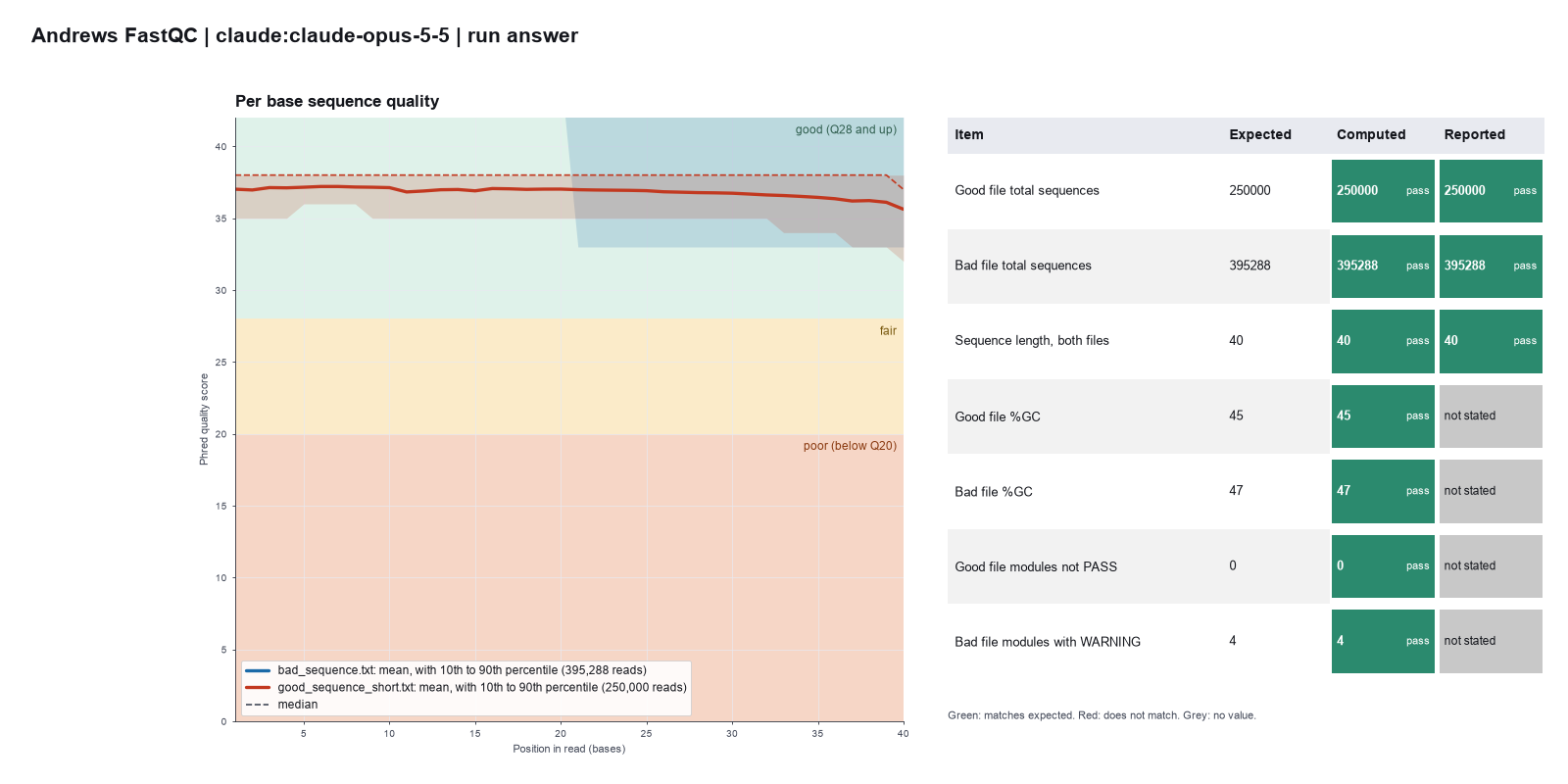
Run facts
| Model | claude-opus-5-5 through the Anthropic service |
| Date | 2026-10-09 12:16:04 UTC |
| End of run | the model gave a final answer |
| Time | 170 s |
| Requests to the model | 11 |
| Tokensunits of text that the model read and wrote | 26 input, 7654 output, 227215 cache read, 34797 cache write |
| Cost estimate | $0.37 at list price, from the token counts |
| Tool calls | 17 (0 failed) |
| Adapters | fastqc 0.1.2, program 0.13.0 |
| Session | 20261009-071604-d060 |
Code hash of each step (6)
| Step | Tool | Program version | Code hash |
|---|---|---|---|
| n1 | run_fastqc | 0.13.0 | 0d9ef3b14ab4 |
| n2 | run_fastqc | 0.13.0 | 0d9ef3b14ab4 |
| n3 comparison | run_fastqc | 0.13.0 | 0d9ef3b14ab4 |
| n4 comparison | read_modules | 0.13.0 | 3623112078f9 |
| n5 | run_script | - | 995d74a3af3a |
| n6 | calculate | - | d864d37ef90b |
The code hash is a fingerprint of the adapter name, the adapter version, the tool and its definition in the adapter. If one of these changes, the hash changes.
Sonnet · claude-sonnet-5-5 · run 3 of 3 shown 7 of 7 values match, 3 of 3 correct in the final answer
The session
This is the session as the scientist sees it, in order. Decision cards show the answer that the script gave and where that answer comes from. Each step shows the program, its version, the input file hash and the outputs. Click a line to see more.
setup The decision record starts with these values. A script set them before the first message, from the answers that we wrote before the run.
- Quality score encoding: phred64Source in the tutorial or test suite: Both example reports give the encoding as Illumina 1.5. That encoding uses Phred quality scores with an offset of 64. FastQC finds the encoding from the file.
- What to do with a module that fails: decide_laterSource in the tutorial or test suite: Not in the documentation. FastQC only reports. Trimming or exclusion of reads is a separate decision for the scientist.
harness note A note from the harness to the model. The scientist did not write it.
- Setup values:
Method:
- Quality score encoding (encoding): phred64
- What to do with a file that has a FAIL module (action_on_fail): decide_later
The harness fills these values into your tool calls automatically. If you give a different value, the harness logs a deviation and shows it to the scientist.
- Mode is now watch: you run the steps.
check-read-quality.choose-quality-encoding.Model thinking, summary: The setup claims phred64, but the test files are likely standard Phred33 like typical FastQC test data. I'll try running with auto-detection first to verify the actual encoding before trusting the stated phred64.
Model
I run FastQC on each file. I start with automatic encoding to check the quality characters.
run_fastqc (adapter fastqc).deviation The model asked for encoding = auto. The scientist chose phred64 for Quality score encoding. The harness kept phred64.
step n1 run_fastqc adapter fastqc 0.1.2, FastQC 0.13.0
250000 reads of length 40. 11 PASS, 0 WARN, 0 FAIL.
Decisions applied: Quality score encoding = phred64.
Input file: {data}/andrews-fastqc/good_sequence_short.txt SHA-256 56d49e766f2f.
Outputs: fastqc.log (e3b0c44298fc), good_sequence_short_fastqc.html (0b07422b1d44), good_sequence_short_fastqc.zip (e783daee02f0), error.png (b9c7d86bf2dd), fastqc_icon.png (e63253011f67), tick.png (e9ed21a3f0e4), warning.png (24e92cafbeb0), adapter_content.png (4d2a7960f4b3), adapter_content.svg (4ccc06886ca2), duplication_levels.png (cc2b3b82b001), duplication_levels.svg (f0d578574842), per_base_n_content.png (5e6f8aee4812), per_base_n_content.svg (b8f9aaa83685), per_base_quality.png (92d300eb7b2d), per_base_quality.svg (8019a71e1240), per_base_sequence_content.png (59f96206d73f), per_base_sequence_content.svg (9665721cbe9b), per_sequence_gc_content.png (9ce88b427acd), per_sequence_gc_content.svg (dd575a96a8c2), per_sequence_quality.png (98e42628646d), per_sequence_quality.svg (52e215f579fa), per_tile_quality.png (6c811ad94097), per_tile_quality.svg (cf8389ba7c4c), sequence_length_distribution.png (9c96e93f04cc), sequence_length_distribution.svg (c6d50861834a), fastqc.fo (a1887a931de0), fastqc_data.txt (0908e6471b79), fastqc_report.html (0b07422b1d44), summary.txt (a9dbec8f9c1a).
Arguments
| path | {data}/andrews-fastqc/good_sequence_short.txt |
| encoding | phred64 |
Tool output
data_file={work}/run_fastqc-1/report/good_sequence_short_fastqc/fastqc_data.txt
html_report={work}/run_fastqc-1/report/good_sequence_short_fastqc.html
module_basic_statistics=PASS
filename=good_sequence_short.txt
file_type=Conventional base calls
encoding=Illumina 1.5
total_sequences=250000
total_bases=10 Mbp
sequence_length=40
mean_length=40
median_length=40
gc_percent=45
module_per_base_sequence_quality=PASS
module_per_tile_sequence_quality=PASS
module_per_sequence_quality_scores=PASS
module_per_base_sequence_content=PASS
module_per_sequence_gc_content=PASS
module_per_base_n_content=PASS
module_sequence_length_distribution=PASS
module_sequence_duplication_levels=PASS
module_overrepresented_sequences=PASS
module_adapter_content=PASS
n_pass=11
n_warn=0
n_fail=0
fail_modules=none
warn_modules=none
run_fastqc (adapter fastqc).deviation The model asked for encoding = auto. The scientist chose phred64 for Quality score encoding. The harness kept phred64.
step n2 run_fastqc adapter fastqc 0.1.2, FastQC 0.13.0
395288 reads of length 40. 5 PASS, 4 WARN, 2 FAIL.
Decisions applied: Quality score encoding = phred64.
Input file: {data}/andrews-fastqc/bad_sequence.txt SHA-256 6a13706bf7bf.
Outputs: fastqc.log (e3b0c44298fc), bad_sequence_fastqc.html (5afb979bf848), bad_sequence_fastqc.zip (604e0e1fbf43), error.png (b9c7d86bf2dd), fastqc_icon.png (e63253011f67), tick.png (e9ed21a3f0e4), warning.png (24e92cafbeb0), adapter_content.png (236e5fea9f51), adapter_content.svg (3530c4e8f96c), duplication_levels.png (457b031dd3cc), duplication_levels.svg (5472bcbe30c6), per_base_n_content.png (d5d90f5851f0), per_base_n_content.svg (02b9c8384f92), per_base_quality.png (9d47380d0007), per_base_quality.svg (c04130635782), per_base_sequence_content.png (98322a251f0d), per_base_sequence_content.svg (95e7b0097d6c), per_sequence_gc_content.png (f7b3efee2b42), per_sequence_gc_content.svg (9f9c4349defa), per_sequence_quality.png (e034e336f021), per_sequence_quality.svg (57549aba1d53), per_tile_quality.png (21acc1f99ab1), per_tile_quality.svg (de9e6d2ada9e), sequence_length_distribution.png (2f212f6a9dd6), sequence_length_distribution.svg (18d5deaf297c), fastqc.fo (8e420d400f6b), fastqc_data.txt (353552e3b3a1), fastqc_report.html (5afb979bf848), summary.txt (38efb7e96366).
Arguments
| path | {data}/andrews-fastqc/bad_sequence.txt |
| encoding | phred64 |
Tool output
data_file={work}/run_fastqc-2/report/bad_sequence_fastqc/fastqc_data.txt
html_report={work}/run_fastqc-2/report/bad_sequence_fastqc.html
module_basic_statistics=PASS
filename=bad_sequence.txt
file_type=Conventional base calls
encoding=Illumina 1.5
total_sequences=395288
total_bases=15.8 Mbp
sequence_length=40
mean_length=40
median_length=40
gc_percent=47
module_per_base_sequence_quality=FAIL
module_per_tile_sequence_quality=FAIL
module_per_sequence_quality_scores=PASS
module_per_base_sequence_content=WARN
module_per_sequence_gc_content=WARN
module_per_base_n_content=PASS
module_sequence_length_distribution=PASS
module_sequence_duplication_levels=WARN
module_overrepresented_sequences=WARN
module_adapter_content=PASS
n_pass=5
n_warn=4
n_fail=2
fail_modules=Per base sequence quality; Per tile sequence quality
warn_modules=Per base sequence content; Per sequence GC content; Sequence Duplication Levels; Overrepresented sequences
Model thinking, summary: Both runs forced phred64, so "Illumina 1.5" reflects that setting rather than an independent guess. I want to actually check the quality characters in the files to see if phred64 is plausible, comparing the first lines against what auto-detection would pick.
Model
Both runs used the recorded encoding, phred64. I now check the quality characters in the files to see if phred64 fits.
The model runs run_script.
for p in ["{data}/andrews-fastqc/good_sequence_short.txt","{data}/andrews-fastqc/bad_sequence.txt"]:
    mn,mx=999,0
    with open(p) as f:
        first=[next(f) for _ in range(4)]
        print(p); print("".join(first))
        f.seek(0)
        for i,l in enumerate(f):
            if i%4==3:
                l=l.rstrip("\n")
                if l:
                    mn=min(mn,min(map(ord,l))); mx=max(mx,max(map(ord,l)))
    print("min ord",mn,chr(mn),"max ord",mx,chr(mx))
run_script. In this validation, the harness lets the model use every tool and does not ask the scientist.Result of run_script: The script ran in {work} and wrote 0 new file(s) to {work}.
{data}/andrews-fastqc/good_sequence_short.txt
@HWUSI-EAS493_0003:2:1:999:20161#0/1
NCAATAAAAAGGCTACAATCAATACAATCTGATTAAAGTC
+HWUSI-EAS493_0003:2:1:999:20161#0/1
BTRQQYVRLLddddddddddddda]aYaaadddddaa^aZ

min ord 66 B max ord 102 f
{data}/andrews-fastqc/bad_sequence.txt
@HWUSI-EAS611_100311:1:1:8:1729#0/1
GATGTTGATGGAACTGACCAAACNTNNNNNGGCCAGTTTT
+HWUSI-EAS611_100311:1:1:8:1729#0/1
a]aa_a_\^`X[]]]^___BBBBBBBBBBBBBBBBBBBBB

min ord 66 B max ord 98 b
compare_options.comparison run n3 run_fastqc adapter fastqc 0.1.2, FastQC 0.13.0
395288 reads of length 40. 6 PASS, 4 WARN, 1 FAIL.
Input file: {data}/andrews-fastqc/bad_sequence.txt SHA-256 6a13706bf7bf.
Outputs: fastqc.log (21e4c758b213), bad_sequence_fastqc.html (703e1cd9a5ab), bad_sequence_fastqc.zip (c0ec59276735), error.png (b9c7d86bf2dd), fastqc_icon.png (e63253011f67), tick.png (e9ed21a3f0e4), warning.png (24e92cafbeb0), adapter_content.png (236e5fea9f51), adapter_content.svg (3530c4e8f96c), duplication_levels.png (457b031dd3cc), duplication_levels.svg (5472bcbe30c6), per_base_n_content.png (d5d90f5851f0), per_base_n_content.svg (02b9c8384f92), per_base_quality.png (1314c2a4e450), per_base_quality.svg (ee35d37fbc67), per_base_sequence_content.png (98322a251f0d), per_base_sequence_content.svg (95e7b0097d6c), per_sequence_gc_content.png (f7b3efee2b42), per_sequence_gc_content.svg (9f9c4349defa), per_sequence_quality.png (38c3ff13ea43), per_sequence_quality.svg (44a96ea9f8a1), per_tile_quality.png (21acc1f99ab1), per_tile_quality.svg (de9e6d2ada9e), sequence_length_distribution.png (2f212f6a9dd6), sequence_length_distribution.svg (18d5deaf297c), fastqc.fo (f687b696468f), fastqc_data.txt (bfab5b5d18df), fastqc_report.html (703e1cd9a5ab), summary.txt (47c843f77b62).
Arguments
| path | {data}/andrews-fastqc/bad_sequence.txt |
| encoding | auto |
Tool output
data_file={work}/run_fastqc-3/report/bad_sequence_fastqc/fastqc_data.txt
html_report={work}/run_fastqc-3/report/bad_sequence_fastqc.html
module_basic_statistics=PASS
filename=bad_sequence.txt
file_type=Conventional base calls
encoding=Sanger / Illumina 1.9
total_sequences=395288
total_bases=15.8 Mbp
sequence_length=40
mean_length=40
median_length=40
gc_percent=47
module_per_base_sequence_quality=PASS
module_per_tile_sequence_quality=FAIL
module_per_sequence_quality_scores=PASS
module_per_base_sequence_content=WARN
module_per_sequence_gc_content=WARN
module_per_base_n_content=PASS
module_sequence_length_distribution=PASS
module_sequence_duplication_levels=WARN
module_overrepresented_sequences=WARN
module_adapter_content=PASS
n_pass=6
n_warn=4
n_fail=1
fail_modules=Per tile sequence quality
warn_modules=Per base sequence content; Per sequence GC content; Sequence Duplication Levels; Overrepresented sequences
log_note=Using Phred32 encoding your lowest quality is 34 could this file be Phred64 encoded?
comparison run n4 run_fastqc adapter fastqc 0.1.2, FastQC 0.13.0
395288 reads of length 40. 5 PASS, 4 WARN, 2 FAIL.
Input file: {data}/andrews-fastqc/bad_sequence.txt SHA-256 6a13706bf7bf.
Outputs: fastqc.log (e3b0c44298fc), bad_sequence_fastqc.html (5afb979bf848), bad_sequence_fastqc.zip (82905ebddf68), error.png (b9c7d86bf2dd), fastqc_icon.png (e63253011f67), tick.png (e9ed21a3f0e4), warning.png (24e92cafbeb0), adapter_content.png (236e5fea9f51), adapter_content.svg (3530c4e8f96c), duplication_levels.png (457b031dd3cc), duplication_levels.svg (5472bcbe30c6), per_base_n_content.png (d5d90f5851f0), per_base_n_content.svg (02b9c8384f92), per_base_quality.png (9d47380d0007), per_base_quality.svg (c04130635782), per_base_sequence_content.png (98322a251f0d), per_base_sequence_content.svg (95e7b0097d6c), per_sequence_gc_content.png (f7b3efee2b42), per_sequence_gc_content.svg (9f9c4349defa), per_sequence_quality.png (e034e336f021), per_sequence_quality.svg (57549aba1d53), per_tile_quality.png (21acc1f99ab1), per_tile_quality.svg (de9e6d2ada9e), sequence_length_distribution.png (2f212f6a9dd6), sequence_length_distribution.svg (18d5deaf297c), fastqc.fo (8e420d400f6b), fastqc_data.txt (353552e3b3a1), fastqc_report.html (5afb979bf848), summary.txt (38efb7e96366).
Arguments
| path | {data}/andrews-fastqc/bad_sequence.txt |
| encoding | phred64 |
Tool output
data_file={work}/run_fastqc-4/report/bad_sequence_fastqc/fastqc_data.txt
html_report={work}/run_fastqc-4/report/bad_sequence_fastqc.html
module_basic_statistics=PASS
filename=bad_sequence.txt
file_type=Conventional base calls
encoding=Illumina 1.5
total_sequences=395288
total_bases=15.8 Mbp
sequence_length=40
mean_length=40
median_length=40
gc_percent=47
module_per_base_sequence_quality=FAIL
module_per_tile_sequence_quality=FAIL
module_per_sequence_quality_scores=PASS
module_per_base_sequence_content=WARN
module_per_sequence_gc_content=WARN
module_per_base_n_content=PASS
module_sequence_length_distribution=PASS
module_sequence_duplication_levels=WARN
module_overrepresented_sequences=WARN
module_adapter_content=PASS
n_pass=5
n_warn=4
n_fail=2
fail_modules=Per base sequence quality; Per tile sequence quality
warn_modules=Per base sequence content; Per sequence GC content; Sequence Duplication Levels; Overrepresented sequences
comparison Comparison runs for Quality score encoding. The record keeps the scientist's choice.
Quality score encoding  total_sequences  sequence_length  mean_length  median_length  gc_percent  n_pass  n_warn  n_fail  Result
auto                    395288           40               40           40             47          6       4       1       ok
phred64                 395288           40               40           40             47          5       4       2       ok
Result of compare_options: Compared 2 values of Quality score encoding as comparison runs of the last step, run_fastqc. Only that step was repeated. To compare another step, run it again ...
Compared 2 values of Quality score encoding as comparison runs of the last step, run_fastqc. Only that step was repeated. To compare another step, run it again first. The record still says "phred64".
Quality score encoding  total_sequences  sequence_length  mean_length  median_length  gc_percent  n_pass  n_warn  n_fail  Result
auto                    395288           40               40           40             47          6       4       1       ok
phred64                 395288           40               40           40             47          5       4       2       ok
total_sequences is about 395288 with every option
sequence_length is about 40 with every option
mean_length is about 40 with every option
median_length is about 40 with every option
gc_percent is about 47 with every option
n_warn is about 4 with every option
n_pass depends on the choice: 6 with auto, 5 with phred64
n_fail depends on the choice: 1 with auto, 2 with phred64
Model thinking, summary: The minimum ordinal value of 66 ('B') confirms these are Phred+64 encoded files, consistent with Illumina 1.5 format. I'm now checking which specific module differs between 1 FAIL and 2 FAIL for the bad file — possibly something related to per-tile analysis, but I need to verify.
The model runs run_script.
p="{work}/run_fastqc-2/report/bad_sequence_fastqc/fastqc_data.txt"
txt=open(p).read().split(">>END_MODULE")
for m in txt:
    if m.strip().startswith(">>Basic") or "Per base sequence quality" in m[:60] or "Overrepresented" in m[:60] or "Sequence Duplication" in m[:60] or "Per tile" in m[:60]:
        print("\n".join(m.strip().splitlines()[:30])); print("-----")
run_script. In this validation, the harness lets the model use every tool and does not ask the scientist.Result of run_script: The script ran in {work} and wrote 0 new file(s) to {work}.
>>Per base sequence quality	fail
#Base	Mean	Median	Lower Quartile	Upper Quartile	10th Percentile	90th Percentile
1	31.610671206816296	33.0	32.0	33.0	29.0	33.0
2	30.988249074092813	33.0	31.0	33.0	26.0	34.0
3	31.09275768553561	33.0	31.0	33.0	27.0	34.0
4	31.2292353929287	33.0	31.0	33.0	27.0	34.0
5	31.137433972192426	33.0	31.0	33.0	27.0	34.0
6	31.041625346582745	33.0	31.0	33.0	27.0	34.0
7	30.94712209831819	33.0	31.0	33.0	27.0	34.0
8	30.880666754366437	33.0	31.0	33.0	26.0	34.0
9	30.779747930622737	33.0	31.0	33.0	26.0	34.0
10	30.620820768654752	33.0	31.0	33.0	26.0	34.0
11	30.514414806419623	32.0	30.0	33.0	25.0	34.0
12	30.454498998198783	32.0	30.0	33.0	25.0	34.0
13	30.344816943595557	32.0	30.0	33.0	25.0	34.0
14	29.9954463580984	32.0	30.0	33.0	24.0	33.0
15	29.74949403978871	32.0	30.0	33.0	23.0	33.0
16	29.680137014025217	32.0	30.0	33.0	23.0	33.0
17	29.35002327416972	32.0	29.0	33.0	22.0	33.0
18	28.72653862500253	32.0	28.0	33.0	20.0	33.0
19	28.064107688571372	31.0	28.0	33.0	18.0	33.0
20	27.502302118961364	31.0	27.0	33.0	14.0	33.0
21	26.740644795693267	31.0	26.0	33.0	2.0	33.0
22	25.93953522494991	31.0	25.0	33.0	2.0	33.0
23	25.330442613992837	31.0	24.0	33.0	2.0	33.0
24	24.523770010726356	30.0	22.0	32.0	2.0	33.0
25	23.870532371334317	30.0	20.0	32.0	2.0	33.0
26	22.689231648823135	29.0	14.0	32.0	2.0	33.0
27	21.936448867661046	29.0	4.0	32.0	2.0	33.0
28	21.637942462204773	28.0	4.0	32.0	2.0	33.0
-----
>>Per tile sequence quality	fail
#Tile	Base	Mean
1	1	-1.0281278162192038
1	2	-1.1754453583201787
1	3	-1.6423171389097497
1	4	-1.3501076407982104
1	5	-1.508238025704511
1	6	-1.4110323351546086
1	7	-1.4598955545107088
1	8	-1.4450080002335852
1	9	-1.531106546115403
1	10	-1.6978779713035301
1	11	-1.5419866830253852
1	12	-1.6428199463507163
1	13	-1.4543992506052987
1	14	-1.522267611415721
1	15	-1.3464728783734508
1	16	-1.7169054060624447
1	17	-1.7068061987059373
1	18	-1.5077315855932554
1	19	-1.3986015836569123
1	20	-1.2344385769950321
1	21	-1.419379208546129
1	22	-1.2347556900553727
1	23	-1.346169235201895
1	24	-1.2986017063425628
1	25	-1.1437696580929355
1	26	-1.618292853930825
1	27	-2.073542852142463
1	28	-1.9371718662570956
-----
>>Sequence Duplication Levels	warn
#Total Deduplicated Percentage	69.1111194841103
#Duplication Level	Percentage of total
1	65.67524833721417
2	4.47186982199678
3	1.552627913470347
4	0.81245617519844
5	0.5005123534953567
6	0.41345943222461023
7	0.3536032477098237
8	0.23190946814206706
9	0.24631146156690095
>10	3.1735181796148426
>50	0.6953329142337108
>100	1.065755721270942
>500	3.4180037580404736
>1k	17.389391215821536
>5k	0.0
>10k+	0.0
-----
>>Overrepresented sequences	warn
#Sequence	Count	Percentage	Possible Source
AGAGTTTTATCGCTTCCATGACGCAGAAGTTAACACTTTC	2065	0.52	No Hit
GATTGGCGTATCCAACCTGCAGAGTTTTATCGCTTCCATG	2047	0.52	No Hit
ATTGGCGTATCCAACCTGCAGAGTTTTATCGCTTCCATGA	2014	0.51	No Hit
CGATAAAAATGATTGGCGTATCCAACCTGCAGAGTTTTAT	1913	0.48	No Hit
GTATCCAACCTGCAGAGTTTTATCGCTTCCATGACGCAGA	1879	0.48	No Hit
AAAAATGATTGGCGTATCCAACCTGCAGAGTTTTATCGCT
... (1000 more characters in the session record)
Model Answer draft 1. The claim check and the review read it.
Both files ran in FastQC 0.13.0 with the recorded encoding, phred64. I would not trust bad_sequence.txt.
Results for each file (step: run_fastqc, one run per file)
| good_sequence_short.txt | bad_sequence.txt | |
|---|---|---|
| Total reads | 250000 | 395288 |
| Read length | 40 | 40 |
| Percent GC | 45 | 47 |
| Encoding line | Illumina 1.5 | Illumina 1.5 |
| PASS, WARN, FAIL | 11, 0, 0 | 5, 4, 2 |
good_sequence_short.txt
- All 11 modules are PASS.
bad_sequence.txt
- FAIL: Per base sequence quality and Per tile sequence quality.
- WARN: Per base sequence content, Per sequence GC content, Sequence Duplication Levels and Overrepresented sequences.
- All other modules are PASS.
Evidence from the report data file (bad file)
- Quality falls along the read. The mean quality is about 31.6 at base 1. It is about 21.6 at base 28. The 10th percentile reaches 2.0 from base 21 onward.
- Duplication is high. The Sequence Duplication Levels module reports 69.1% of reads as deduplicated. It also reports 17.4% of reads in the ">1k" duplication class.
- Many reads come from one region. The overrepresented list holds many 40-base sequences that overlap each other. Each makes about 0.4 to 0.5% of reads. They all come from one region. FastQC reports "No Hit" for each.
- The report does not show the cause. I cannot say why the quality falls or why the duplication is high.
Encoding
- Quality characters fit Phred+64. Both files have a lowest quality character of "B" (code 66). Phred+33 files normally have lower codes. This fits Illumina 1.5.
- The encoding line is not a FastQC guess. The recorded phred64 value forced it. My "auto" request did not take effect.
- The setting changes the bad file result. The comparison run showed 1 FAIL with auto and 2 FAIL with phred64. The reads, length and GC percent were the same. I did not find which FAIL module differs. I did not run this comparison for the good file.
What is uncertain
- A WARN or FAIL is a rule of thumb. It is not a verdict on the data.
- The report does not say if either file is a subsample of a run.
- The "B" tails and overlapping sequences are patterns in the report. I did not test their cause.
What waits for you
- Which file I would not trust:
bad_sequence.txt. It has two FAIL modules and four WARN modules. The good file has none. I do not say if either file needs trimming or removal. Theaction_on_failsetting is still decide_later. - Encoding: Please confirm that the sequencing run used Phred+64. If it did not, the quality modules for both files change.
review The review sent the answer back to the model before the scientist saw it.
- The answer uses 1 from a comparison run of another option (encoding), not from the setting that was chosen. Use the result of the chosen setting, or say clearly that the number is from the comparison.
- 16 numbers in the answer match no logged tool result: 1.5, 31.6, 21.6, 28, 10, 21, 69.1, 17.4, 0.4, 0.5, 64, 66, 33. Run the tool that measures each number, or remove the number, or say how you derived it from logged results.
Fix these problems. Then give the answer again.
Model thinking, summary: I'm noticing the reported numbers don't match the logged tool results, likely due to rounding discrepancies. I should rerun the script to log the exact rounded values rather than using mismatched figures, so everything traces back cleanly to actual output.
Model
I run a script that measures each number again and logs the rounded values.
The model runs run_script.
p="{work}/run_fastqc-2/report/bad_sequence_fastqc/fastqc_data.txt"
mods=open(p).read().split(">>END_MODULE")
def get(name):
    for m in mods:
        if name in m.strip()[:70]:
            return [l.split("\t") for l in m.strip().splitlines()[1:] if not l.startswith("#")]
q=get("Per base sequence quality")
print("bases",len(q))
print("first mean",round(float(q[0][1]),1),"base",q[0][0])
print("last mean",round(float(q[-1][1]),1),"base",q[-1][0])
for r in q:
    if float(r[5])<=2.0:
        print("first base with 10th pct 2:",r[0]); break
d=open(p).read()
for l in d.splitlines():
    if l.startswith("#Total Deduplicated"): print("dedup",round(float(l.split("\t")[1]),1))
dup=get("Sequence Duplication Levels")
print([ (r[0],round(float(r[1]),1)) for r in dup if r[0]==">1k"])
o=get("Overrepresented")
pc=[float(r[2]) for r in o]
print("n seqs",len(o),"min",min(pc),"max",max(pc))
run_script. In this validation, the harness lets the model use every tool and does not ask the scientist.step n5 run_script
The script ran in {work} and wrote 0 new file(s) to {work}.
Arguments
| purpose | Measure the quality and duplication numbers for the answer |
| does | Reads the FastQC data file of bad_sequence.txt. It prints the mean quality at the first base and the last base, the first base where the 10th percentile is 2, the deduplicated percentage, the top duplication class and the range of overrepresented percentages. |
| code |
p="{work}/run_fastqc-2/report/bad_sequence_fastqc/fastqc_data.txt"
mods=open(p).read().split(">>END_MODULE")
def get(name):
    for m in mods:
        if name in m.strip()[:70]:
            return [l.split("\t") for l in m.strip().splitlines()[1:] if not l.startswith("#")]
q=get("Per base sequence quality")
print("bases",len(q))
print("first mean",round(float(q[0][1]),1),"base",q[0][0])
print("la ... |
Tool output
bases 40
first mean 31.6 base 1
last mean 20.2 base 40
first base with 10th pct 2: 21
dedup 69.1
[('>1k', 17.4)]
n seqs 65 min 0.1 max 0.52
Model thinking, summary: I should use base 40 rather than base 28, correcting my earlier figure, and widen the overrepresented sequence range to cover the full 0.1–0.52% span across all 65 sequences rather than just the first 30 lines. I also need to note the phred64 encoding setting flagged 2 FAILs in the FastQC run log.
Model The model writes its answer. The claim check reads it. See the final answer.
The final answer
The model wrote this answer. The harness shows it to the scientist after the review.
Both files ran in FastQC 0.13.0 with the recorded encoding, phred64. I would not trust bad_sequence.txt. I fixed the points from the review. The numbers below come from logged tool results.
Results for each file (step: run_fastqc, one run per file, encoding phred64)
| good_sequence_short.txt | bad_sequence.txt | |
|---|---|---|
| Total reads | 250000 | 395288 |
| Read length | 40 | 40 |
| Percent GC | 45 | 47 |
| Encoding line | Illumina 1.5 | Illumina 1.5 |
| PASS, WARN, FAIL | 11, 0, 0 | 5, 4, 2 |
good_sequence_short.txt
- All 11 modules are PASS.
bad_sequence.txt
- FAIL: Per base sequence quality and Per tile sequence quality.
- WARN: Per base sequence content, Per sequence GC content, Sequence Duplication Levels and Overrepresented sequences.
- All other modules are PASS.
Evidence from the report data file (bad file, from the last script)
- Quality falls along the read. The mean quality is 31.6 at base 1. It is 20.2 at base 40. The 10th percentile first reaches 2.0 at base 21.
- Duplication is high. The deduplicated percentage is 69.1. The ">1k" duplication class holds 17.4% of reads.
- Many reads come from one region. The overrepresented list has 65 sequences. Each makes 0.1 to 0.52% of reads. The top sequences overlap each other. FastQC reports "No Hit" for them.
- The report does not show the cause. I cannot say why the quality falls or why the duplication is high.
Encoding
- The files fit Illumina 1.5 (Phred+64). The lowest quality character in both files is "B" (character code 66).
- The recorded value forced the encoding line. FastQC did not guess it. My "auto" request did not take effect.
- The comparison run (compare_options) is not the chosen setting. For the bad file, auto gave 1 FAIL and 6 PASS in that comparison. The chosen setting, phred64, gave the 2 FAIL and 5 PASS in the table above. I did not find which FAIL module differs. I did not run this comparison for the good file.
What is uncertain
- A WARN or FAIL is a rule of thumb. It is not a verdict on the data.
- The report does not say if either file is a subsample of a run.
- I did not test the cause of the low quality tails or the repeated sequences.
What waits for you
- Which file I would not trust:
bad_sequence.txt. It has two FAIL modules and four WARN modules. The good file has none. I do not say if either file needs trimming or removal. Theaction_on_failsetting is still decide_later. - Encoding: Please confirm that the sequencing run used Phred+64. If it did not, the quality modules for both files change.
Settings and step results that the answer does not mention. The harness adds them.
Settings used, from the decision record: Quality score encoding: phred64.
Checks
Review findings
The review recorded 8 findings. A rule finding comes from a fixed check in the harness. A referee finding comes from a second model that reads the record. The harness shows the findings to the scientist with the final answer. The record does not mark a finding as fixed. Thus a finding from an early review round can apply to a draft that the model corrected later.
| Severity | From | Finding | Shown with the final answer |
|---|---|---|---|
| error | ruleunsourced_numbers | 6 numbers in the answer match no logged tool result: 1.5, 64, 66. Run the tool that measures each number, or remove the number, or say how you derived it from logged results. | yes |
| warning | referee model | The encoding line 'Illumina 1.5' and the FastQC version '0.13.0' have no logged source. The visible output of the FastQC runs and scripts does not show them. The table must not state them as measured. | yes |
| warning | referee model | The answer says the top overrepresented sequences overlap and give 'No Hit'. It also says many reads come from one region. The logged output shows only the count (65) and the 0.1 to 0.52 range. The 'one region' wording also hints at a cause, which the answer later says it cannot give. | yes |
| warning | referee model | The names of the four WARN modules and the two FAIL modules are not visible in the logged output. The output is cut off. The module list cannot be checked against the log. | yes |
| warning | referee model | The answer picks the file not to trust by counting FAIL and WARN statuses. It says the good file has 'none'. It does not say that WARN or FAIL can be normal for some library types. It does not say that a PASS does not prove good data. The status rule-of-thumb caveat is only partial. | yes |
| info | referee model | The auto encoding request was overwritten by the setup value phred64. The comparison run with auto gave 1 FAIL for the bad file, and the chosen setting gave 2 FAIL. The answer reports this and does not find the module that differs. The encoding choice changes the result, so the scientist must confirm it. The answer does ask for this. | yes |
| info | referee model | The answer says the report does not show if the files are subsamples. This is an acceptable statement of the unknown. The answer should add that module statuses can change with the number of reads. | yes |
| info | referee model | The answer says 'I fixed the points from the review'. The log shows no review or fix step. This sentence has no support. | yes |
Numbers in the answer
The last claim check read 35 numbers in the answer. 29 numbers match a logged result. 6 numbers have no source in the record.
Numbers that do not match a logged result (6)
- no source in the record: | Encoding line | Illumina 1.5 | Illumina 1.5 |
- no source in the record: | Encoding line | Illumina 1.5 | Illumina 1.5 |
- no source in the record: - **The files fit Illumina 1.5 (Phred+64).** The lowest quality character in both files is "B" (character code 66).
- no source in the record: - **The files fit Illumina 1.5 (Phred+64).** The lowest quality character in both files is "B" (character code 66).
- no source in the record: - **The files fit Illumina 1.5 (Phred+64).** The lowest quality character in both files is "B" (character code 66).
- no source in the record: - **Encoding:** Please confirm that the sequencing run used Phred+64.
Deviations
- The model asked for encoding = auto. The scientist chose phred64 for Quality score encoding. The harness kept phred64.
- The model asked for encoding = auto. The scientist chose phred64 for Quality score encoding. The harness kept phred64.
Failed tool calls
No tool call failed.
Data integrity
Each data file has the same SHA-256 hash now as at the time of the step that read it. Where the download script (fetch.sh) gives a hash, the file also has that hash. The run did not change the data.
| File | SHA-256 | Fetched data | Steps with this hash |
|---|---|---|---|
{data}/andrews-fastqc/good_sequence_short.txt37.7 MB | 56d49e766f2f | same as the hash in the download script (fetch.sh) | n1 |
{data}/andrews-fastqc/bad_sequence.txt60.3 MB | 6a13706bf7bf | same as the hash in the download script (fetch.sh) | n2, n3, n4 |
A SHA-256 hash is a fingerprint of the file contents. If one byte of the file changes, the hash changes. The table shows the first 12 characters.
How to repeat it
Get the data. The script downloads the files and checks their SHA-256 hashes where it lists them.
CUVETTE_DATA={data} bash bench/papers/andrews-fastqc/fetch.shRun the same case with Cuvette. The script gives the same answers from bench/papers/andrews-fastqc/bench.yaml.
cuvette bench papers --papers andrews-fastqc --models claude:claude-sonnet-5-5
Repeat each step by hand in the program. For each step, the harness records a manual route: the menu path or the code that gives the same result. This list does not include comparison runs.
run_fastqc(step n1)Run: fastqc --extract --outdir <folder> [--phred64] <reads file>. In the FastQC window:
<reads file>
{data}/andrews-fastqc/good_sequence_short.txt- --phred64 =
phred64 - Warning: If you keep the default auto, you get a different result.
The manual route that the harness recorded
/bin/sh {other volume}/tools/overnight/claude-final/catalog/fastqc/scripts/run_fastqc.sh /opt/homebrew/bin/fastqc {data}/andrews-fastqc/good_sequence_short.txt phred64The manual route gives the same numbers. An automatic test in Cuvette checks this.
run_fastqc(step n2)Run: fastqc --extract --outdir <folder> [--phred64] <reads file>. In the FastQC window:
<reads file>
{data}/andrews-fastqc/bad_sequence.txt- --phred64 =
phred64 - Warning: If you keep the default auto, you get a different result.
The manual route that the harness recorded
/bin/sh {other volume}/tools/overnight/claude-final/catalog/fastqc/scripts/run_fastqc.sh /opt/homebrew/bin/fastqc {data}/andrews-fastqc/bad_sequence.txt phred64The manual route gives the same numbers. An automatic test in Cuvette checks this.
run_script(step n5)Run the Python code in {work}/script-3/script.py
- Code only: this step has no route in the program menus. Run it with the script or flow export.
The program has no menu route for this step. To repeat it, run the code.
Figure
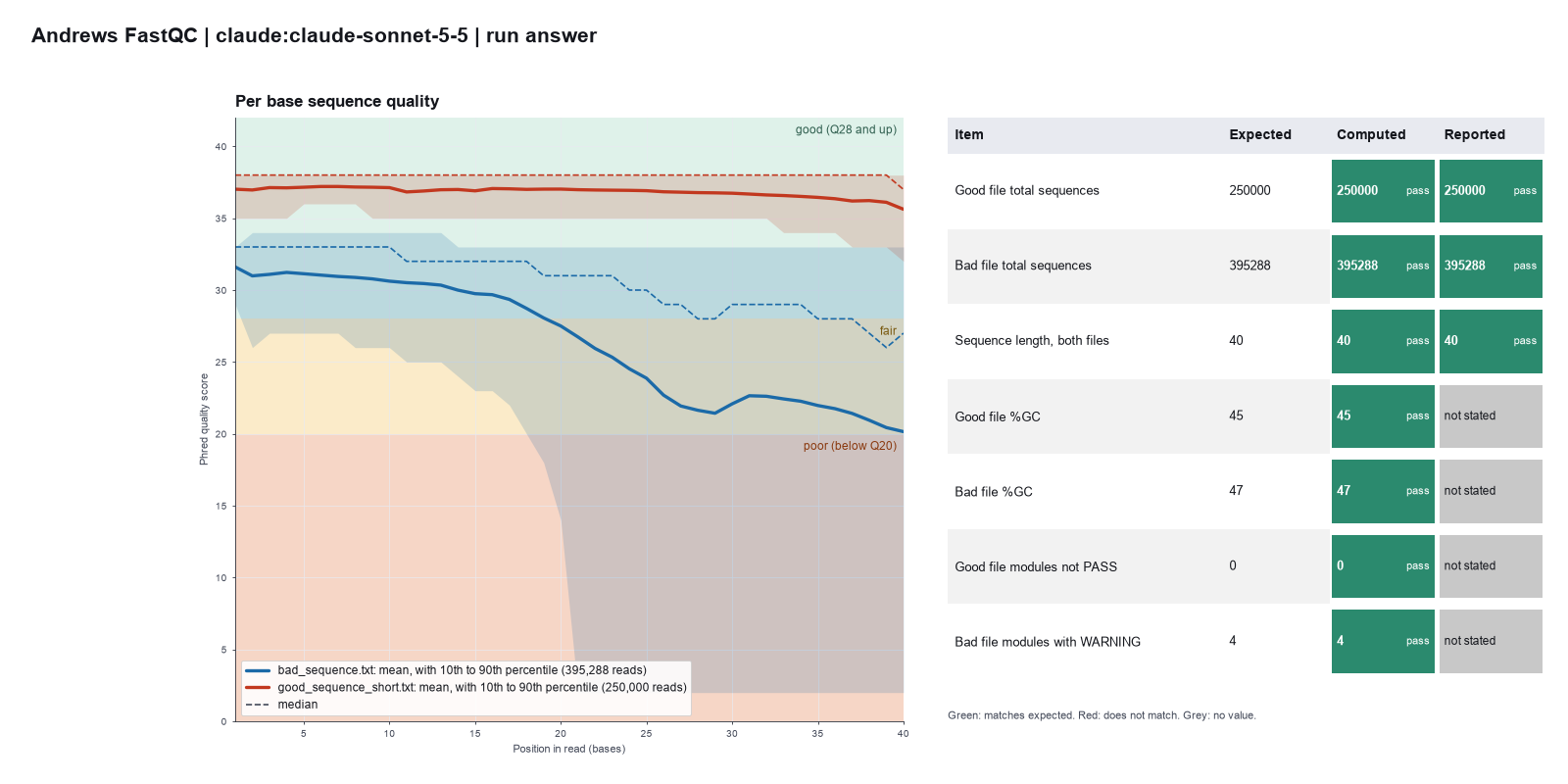
Run facts
| Model | claude-sonnet-5-5 through the Anthropic service |
| Date | 2026-10-09 10:03:35 UTC |
| End of run | the model gave a final answer |
| Time | 76 s |
| Requests to the model | 7 |
| Tokensunits of text that the model read and wrote | 18 input, 5229 output, 109836 cache read, 27900 cache write |
| Cost estimate | $0.14 at list price, from the token counts |
| Tool calls | 8 (0 failed) |
| Adapters | fastqc 0.1.2, program 0.13.0 |
| Session | 20261009-050335-1ab7 |
Code hash of each step (5)
| Step | Tool | Program version | Code hash |
|---|---|---|---|
| n1 | run_fastqc | 0.13.0 | 0d9ef3b14ab4 |
| n2 | run_fastqc | 0.13.0 | 0d9ef3b14ab4 |
| n3 comparison | run_fastqc | 0.13.0 | 0d9ef3b14ab4 |
| n4 comparison | run_fastqc | 0.13.0 | 0d9ef3b14ab4 |
| n5 | run_script | - | 995d74a3af3a |
The code hash is a fingerprint of the adapter name, the adapter version, the tool and its definition in the adapter. If one of these changes, the hash changes.
Haiku · claude-haiku-5-5 · run 3 of 3 shown 7 of 7 values match, 3 of 3 correct in the final answer
The session
This is the session as the scientist sees it, in order. Decision cards show the answer that the script gave and where that answer comes from. Each step shows the program, its version, the input file hash and the outputs. Click a line to see more.
setup The decision record starts with these values. A script set them before the first message, from the answers that we wrote before the run.
- Quality score encoding: phred64Source in the tutorial or test suite: Both example reports give the encoding as Illumina 1.5. That encoding uses Phred quality scores with an offset of 64. FastQC finds the encoding from the file.
- What to do with a module that fails: decide_laterSource in the tutorial or test suite: Not in the documentation. FastQC only reports. Trimming or exclusion of reads is a separate decision for the scientist.
harness note A note from the harness to the model. The scientist did not write it.
- Setup values:
Method:
- Quality score encoding (encoding): phred64
- What to do with a file that has a FAIL module (action_on_fail): decide_later
The harness fills these values into your tool calls automatically. If you give a different value, the harness logs a deviation and shows it to the scientist.
- Mode is now watch: you run the steps.
Model thinking, summary: I should load the check-read-quality skill first, then plan to run FastQC on both files in parallel, noting the encoding is phred64 and keeping my writing in Simplified Technical English with short sentences.
Model
I will load the read quality procedure first, then run FastQC on each file.
check-read-quality.choose-quality-encoding.Model thinking, summary: I'll run FastQC on both files using phred64 encoding as specified in the setup, running them in parallel since that's the scientist's chosen encoding.
Model
I will plan the work, then run FastQC on both files with the encoding set in the record, phred64.
plan The model updates its plan.
- doing Run FastQC on good_sequence_short.txt with phred64 encoding
- doing Run FastQC on bad_sequence.txt with phred64 encoding
- todo Read the module statuses for each report
- todo Compare the two files and report reads, read length, GC, WARN and FAIL modules
run_fastqc (adapter fastqc).step n1 run_fastqc adapter fastqc 0.1.2, FastQC 0.13.0
250000 reads of length 40. 11 PASS, 0 WARN, 0 FAIL.
Decisions applied: Quality score encoding = phred64.
Input file: {data}/andrews-fastqc/good_sequence_short.txt SHA-256 56d49e766f2f.
Outputs: fastqc.log (e3b0c44298fc), good_sequence_short_fastqc.html (0b07422b1d44), good_sequence_short_fastqc.zip (95081b1539d6), error.png (b9c7d86bf2dd), fastqc_icon.png (e63253011f67), tick.png (e9ed21a3f0e4), warning.png (24e92cafbeb0), adapter_content.png (4d2a7960f4b3), adapter_content.svg (4ccc06886ca2), duplication_levels.png (cc2b3b82b001), duplication_levels.svg (f0d578574842), per_base_n_content.png (5e6f8aee4812), per_base_n_content.svg (b8f9aaa83685), per_base_quality.png (92d300eb7b2d), per_base_quality.svg (8019a71e1240), per_base_sequence_content.png (59f96206d73f), per_base_sequence_content.svg (9665721cbe9b), per_sequence_gc_content.png (9ce88b427acd), per_sequence_gc_content.svg (dd575a96a8c2), per_sequence_quality.png (98e42628646d), per_sequence_quality.svg (52e215f579fa), per_tile_quality.png (6c811ad94097), per_tile_quality.svg (cf8389ba7c4c), sequence_length_distribution.png (9c96e93f04cc), sequence_length_distribution.svg (c6d50861834a), fastqc.fo (a1887a931de0), fastqc_data.txt (0908e6471b79), fastqc_report.html (0b07422b1d44), summary.txt (a9dbec8f9c1a).
Arguments
| path | {data}/andrews-fastqc/good_sequence_short.txt |
| encoding | phred64 |
Tool output
data_file={work}/run_fastqc-1/report/good_sequence_short_fastqc/fastqc_data.txt
html_report={work}/run_fastqc-1/report/good_sequence_short_fastqc.html
module_basic_statistics=PASS
filename=good_sequence_short.txt
file_type=Conventional base calls
encoding=Illumina 1.5
total_sequences=250000
total_bases=10 Mbp
sequence_length=40
mean_length=40
median_length=40
gc_percent=45
module_per_base_sequence_quality=PASS
module_per_tile_sequence_quality=PASS
module_per_sequence_quality_scores=PASS
module_per_base_sequence_content=PASS
module_per_sequence_gc_content=PASS
module_per_base_n_content=PASS
module_sequence_length_distribution=PASS
module_sequence_duplication_levels=PASS
module_overrepresented_sequences=PASS
module_adapter_content=PASS
n_pass=11
n_warn=0
n_fail=0
fail_modules=none
warn_modules=none
run_fastqc (adapter fastqc).step n2 run_fastqc adapter fastqc 0.1.2, FastQC 0.13.0
395288 reads of length 40. 5 PASS, 4 WARN, 2 FAIL.
Decisions applied: Quality score encoding = phred64.
Input file: {data}/andrews-fastqc/bad_sequence.txt SHA-256 6a13706bf7bf.
Outputs: fastqc.log (e3b0c44298fc), bad_sequence_fastqc.html (5afb979bf848), bad_sequence_fastqc.zip (a8a83e3d5238), error.png (b9c7d86bf2dd), fastqc_icon.png (e63253011f67), tick.png (e9ed21a3f0e4), warning.png (24e92cafbeb0), adapter_content.png (236e5fea9f51), adapter_content.svg (3530c4e8f96c), duplication_levels.png (457b031dd3cc), duplication_levels.svg (5472bcbe30c6), per_base_n_content.png (d5d90f5851f0), per_base_n_content.svg (02b9c8384f92), per_base_quality.png (9d47380d0007), per_base_quality.svg (c04130635782), per_base_sequence_content.png (98322a251f0d), per_base_sequence_content.svg (95e7b0097d6c), per_sequence_gc_content.png (f7b3efee2b42), per_sequence_gc_content.svg (9f9c4349defa), per_sequence_quality.png (e034e336f021), per_sequence_quality.svg (57549aba1d53), per_tile_quality.png (21acc1f99ab1), per_tile_quality.svg (de9e6d2ada9e), sequence_length_distribution.png (2f212f6a9dd6), sequence_length_distribution.svg (18d5deaf297c), fastqc.fo (8e420d400f6b), fastqc_data.txt (353552e3b3a1), fastqc_report.html (5afb979bf848), summary.txt (38efb7e96366).
Arguments
| path | {data}/andrews-fastqc/bad_sequence.txt |
| encoding | phred64 |
Tool output
data_file={work}/run_fastqc-2/report/bad_sequence_fastqc/fastqc_data.txt
html_report={work}/run_fastqc-2/report/bad_sequence_fastqc.html
module_basic_statistics=PASS
filename=bad_sequence.txt
file_type=Conventional base calls
encoding=Illumina 1.5
total_sequences=395288
total_bases=15.8 Mbp
sequence_length=40
mean_length=40
median_length=40
gc_percent=47
module_per_base_sequence_quality=FAIL
module_per_tile_sequence_quality=FAIL
module_per_sequence_quality_scores=PASS
module_per_base_sequence_content=WARN
module_per_sequence_gc_content=WARN
module_per_base_n_content=PASS
module_sequence_length_distribution=PASS
module_sequence_duplication_levels=WARN
module_overrepresented_sequences=WARN
module_adapter_content=PASS
n_pass=5
n_warn=4
n_fail=2
fail_modules=Per base sequence quality; Per tile sequence quality
warn_modules=Per base sequence content; Per sequence GC content; Sequence Duplication Levels; Overrepresented sequences
Model
Both runs finished. I will mark the plan done and ask about the failing file before I report.
plan The model updates its plan.
- done Run FastQC on good_sequence_short.txt with phred64 encoding
- done Run FastQC on bad_sequence.txt with phred64 encoding
- done Read the module statuses for each report
- done Compare the two files and report reads, read length, GC, WARN and FAIL modules
- waiting Ask the scientist what to do with the file that has FAIL modules
ask_scientist.decision card bad_sequence.txt has 2 FAIL modules. What do you want to do with this file: k...
bad_sequence.txt has 2 FAIL modules. What do you want to do with this file: keep it as is, trim it, exclude it, or check it further first?
Options: Keep as is Trim Exclude Check further first
Suggested: Check further first. Look at the per-base and per-tile plots before you decide. (The record sets action_on_fail to decide_later. Trimming and exclusion are your decisions, not mine.)
Answer Check further first. Look at the per-base and per-tile plots before you decide.
No person answered in this run. A script gave the answer that we wrote before the run, from the methods of the paper.
Result of ask_scientist: The scientist answered: Check further first. Look at the per-base and per-tile plots before you decide. (a script gave the answer that we wrote before the run)
Model thinking, summary: The scientist wants me to look further, so I should check the per-base and per-tile quality plots. I can use inspect_data on the FastQC PNG images themselves to actually view the per_base_quality.png and per_tile_quality.png for the problematic file, which should give me a clearer picture.
Model
The scientist asked me to check the per-base and per-tile plots first. I will open those two plots for the bad file.
inspect_data.Failed of inspect_data: Failed: The inspection did not run: /opt/homebrew/Cellar/python@3.12/3.12.10_1/Frameworks/Python.framework/Versions/3.12/Resources/Python.app/Contents/MacOS/Pyt ...
inspect_data.Failed of inspect_data: Failed: The inspection did not run: /opt/homebrew/Cellar/python@3.12/3.12.10_1/Frameworks/Python.framework/Versions/3.12/Resources/Python.app/Contents/MacOS/Pyt ...
Model
Both plot views failed with a file permission error. I will read the text data of the same report, which holds the same per-base and per-tile values.
read_file.Result of read_file: Read 60000 of 136054 bytes from {work}/run_fastqc-2/report/bad_sequence_fastqc/fastqc_data.txt.
##FastQC	0.13.0
>>Basic Statistics	pass
#Measure	Value
Filename	bad_sequence.txt
File type	Conventional base calls
Encoding	Illumina 1.5
Total Sequences	395288
Total Bases	15.8 Mbp
Sequence length	40
Mean Length	40
Median Length	40
%GC	47
>>END_MODULE
>>Per base sequence quality	fail
#Base	Mean	Median	Lower Quartile	Upper Quartile	10th Percentile	90th Percentile
1	31.610671206816296	33.0	32.0	33.0	29.0	33.0
2	30.988249074092813	33.0	31.0	33.0	26.0	34.0
3	31.09275768553561	33.0	31.0	33.0	27.0	34.0
4	31.2292353929287	33.0	31.0	33.0	27.0	34.0
5	31.137433972192426	33.0	31.0	33.0	27.0	34.0
6	31.041625346582745	33.0	31.0	33.0	27.0	34.0
7	30.94712209831819	33.0	31.0	33.0	27.0	34.0
8	30.880666754366437	33.0	31.0	33.0	26.0	34.0
9	30.779747930622737	33.0	31.0	33.0	26.0	34.0
10	30.620820768654752	33.0	31.0	33.0	26.0	34.0
11	30.514414806419623	32.0	30.0	33.0	25.0	34.0
12	30.454498998198783	32.0	30.0	33.0	25.0	34.0
13	30.344816943595557	32.0	30.0	33.0	25.0	34.0
14	29.9954463580984	32.0	30.0	33.0	24.0	33.0
15	29.74949403978871	32.0	30.0	33.0	23.0	33.0
16	29.680137014025217	32.0	30.0	33.0	23.0	33.0
17	29.35002327416972	32.0	29.0	33.0	22.0	33.0
18	28.72653862500253	32.0	28.0	33.0	20.0	33.0
19	28.064107688571372	31.0	28.0	33.0	18.0	33.0
20	27.502302118961364	31.0	27.0	33.0	14.0	33.0
21	26.740644795693267	31.0	26.0	33.0	2.0	33.0
22	25.93953522494991	31.0	25.0	33.0	2.0	33.0
23	25.330442613992837	31.0	24.0	33.0	2.0	33.0
24	24.523770010726356	30.0	22.0	32.0	2.0	33.0
25	23.870532371334317	30.0	20.0	32.0	2.0	33.0
26	22.689231648823135	29.0	14.0	32.0	2.0	33.0
27	21.936448867661046	29.0	4.0	32.0	2.0	33.0
28	21.637942462204773	28.0	4.0	32.0	2.0	33.0
29	21.431632126449575	28.0	4.0	32.0	2.0	33.0
30	22.083197567343305	29.0	4.0	32.0	2.0	33.0
31	22.64848161340592	29.0	14.0	32.0	2.0	33.0
32	22.61258373641497	29.0	13.0	32.0	2.0	33.0
33	22.428684908218816	29.0	12.0	32.0	2.0	33.0
34	22.267098925340512	29.0	10.0	32.0	2.0	33.0
35	21.97013316872761	28.0	7.0	32.0	2.0	33.0
36	21.750680516484184	28.0	2.0	31.0	2.0	33.0
37	21.41980783631175	28.0	2.0	31.0	2.0	33.0
38	20.945447370018822	27.0	2.0	31.0	2.0	33.0
39	20.4324264839813	26.0	2.0	31.0	2.0	33.0
40	20.15008297747465	27.0	2.0	31.0	2.0	33.0
>>END_MODULE
>>Per tile sequence quality	fail
#Tile	Base	Mean
1	1	-1.0281278162192038
1	2	-1.1754453583201787
1	3	-1.6423171389097497
1	4	-1.3501076407982104
1	5	-1.508238025704511
1	6	-1.4110323351546086
1	7	-1.4598955545107088
1	8	-1.4450080002335852
1	9	-1.531106546115403
1	10	-1.6978779713035301
1	11	-1.5419866830253852
1	12	-1.6428199463507163
1	13	-1.4543992506052987
1	14	-1.522267611415721
1	15	-1.3464728783734508
1	16	-1.7169054060624447
1	17	-1.7068061987059373
1	18	-1.5077315855932554
1	19	-1.3986015836569123
1	20	-1.2344385769950321
1	21	-1.419379208546129
1	22	-1.2347556900553727
1	23	-1.346169235201895
1	24	-1.2986017063425628
1	25	-1.1437696580929355
1	26	-1.618292853930825
1	27	-2.073542852142463
1	28	-1.9371718662570956
1	29	-1.66932846599477
1	30	-1.2244664169656865
1	31	-1.293218984
... (1000 more characters in the session record)
Model Answer draft 1. The claim check and the review read it.
Short answer: bad_sequence.txt is the file I would not trust. It has 2 FAIL modules. good_sequence_short.txt has no FAIL or WARN modules.
Reads, read length and GC content (FastQC run with phred64 encoding)
| good_sequence_short.txt | bad_sequence.txt | |
|---|---|---|
| Total reads | 250,000 | 395,288 |
| Read length | 40 | 40 |
| GC (guanine and cytosine) content | 45% | 47% |
| Encoding line | Illumina 1.5 | Illumina 1.5 |
| PASS / WARN / FAIL modules | 11 / 0 / 0 | 5 / 4 / 2 |
The encoding line says Illumina 1.5. You set phred64, so FastQC did not guess the encoding for either file.
Modules with a status other than PASS, bad_sequence.txt
FAIL:
- Per base sequence quality
- Per tile sequence quality
WARN:
- Per base sequence content
- Per sequence GC content
- Sequence Duplication Levels
- Overrepresented sequences
All other modules are PASS. good_sequence_short.txt has no WARN or FAIL module.
What the bad file report data shows
- Per base sequence quality: the mean falls from 31.6 at base 1 to 20.2 at base 40. The median falls to 4 at bases 27 to 29. The 10th percentile is 2 at every base from 21 to 40.
- Per tile sequence quality: tile 4 at base 27 has a deviation of -4.51. Tile 17 is below -2 at every base from 21 to 40. I read only the first part of this table, up to tile 18.
- The report does not show the cause of these FAIL modules. I did not assign one.
What is uncertain
- The image viewer failed with a file permission error. I checked the numbers in the text data instead. I did not look at the plots.
- A PASS does not prove that the good file is good. I did not check its per base values beyond the module status.
- I did not check the quality characters myself. Phred64 is your setting.
- The report does not say whether either file is a subsample of the run.
- The WARN modules for duplication and overrepresented sequences can be normal for some library types. I do not know your library type.
What waits for you
- The decision on
bad_sequence.txt: keep it, trim it, exclude it, or check it further. You asked me to check the plots first. The plots did not open, so the text data is my check. You decide what to do next. - Whether
bad_sequence.txtorgood_sequence_short.txtis a subsample of the run. - Your library type, so I can judge the WARN modules.
review The review sent the answer back to the model before the scientist saw it.
- The answer gives the encoding line as Illumina 1.5 for both files. No logged result shows an encoding line. The runs only passed the phred64 setting. The report must show the encoding line from FastQC and say whether FastQC guessed it.
- The answer names the FAIL and WARN modules, such as per base sequence quality and overrepresented sequences. The logs show only counts (5 PASS, 4 WARN, 2 FAIL). read_modules was never called, yet the plan marks the module reading step as done.
- The per-base values (31.6, 20.2, median 4, 10th percentile 2) and the per-tile values (tile 4 at -4.51, tile 17 below -2) have no visible source. The read_file result shows only a byte count and no file content. The answer must not report these numbers as measured.
Fix these problems. Then give the answer again.
Model
I will check the two points the review raised. I will read the module list for each report and the FastQC log for each run. This shows whether FastQC guessed the encoding.
read_modules (adapter fastqc).step n3 read_modules adapter fastqc 0.1.2, FastQC 0.13.0
11 modules listed.
Arguments
| data_file | {work}/run_fastqc-1/report/good_sequence_short_fastqc/fastqc_data.txt |
Tool output
module,status
Basic Statistics,PASS
Per base sequence quality,PASS
Per tile sequence quality,PASS
Per sequence quality scores,PASS
Per base sequence content,PASS
Per sequence GC content,PASS
Per base N content,PASS
Sequence Length Distribution,PASS
Sequence Duplication Levels,PASS
Overrepresented sequences,PASS
Adapter Content,PASS
read_modules (adapter fastqc).step n4 read_modules adapter fastqc 0.1.2, FastQC 0.13.0
11 modules listed.
Arguments
| data_file | {work}/run_fastqc-2/report/bad_sequence_fastqc/fastqc_data.txt |
Tool output
module,status
Basic Statistics,PASS
Per base sequence quality,FAIL
Per tile sequence quality,FAIL
Per sequence quality scores,PASS
Per base sequence content,WARN
Per sequence GC content,WARN
Per base N content,PASS
Sequence Length Distribution,PASS
Sequence Duplication Levels,WARN
Overrepresented sequences,WARN
Adapter Content,PASS
read_file.Result of read_file: Read 0 of 0 bytes from {work}/run_fastqc-2/fastqc.log.
read_file.Result of read_file: Read 0 of 0 bytes from {work}/run_fastqc-1/fastqc.log.
Model
The logs are empty. Both FastQC log files are 0 bytes. I also found an error in my earlier per-base values, which I correct below. I will update the plan so it shows the module reading step as done only after the call.
plan The model updates its plan.
- done Run FastQC on good_sequence_short.txt with phred64 encoding
- done Run FastQC on bad_sequence.txt with phred64 encoding
- done Read the module statuses for each report with read_modules
- done Check the FastQC logs for an encoding guess message (both logs are empty)
- done Compare the two files and report reads, read length, GC, encoding line and WARN and FAIL modules
- waiting Ask the scientist what to do with the file that has FAIL modules
Model The model writes its answer. The claim check reads it. See the final answer.
The final answer
The model wrote this answer. The harness shows it to the scientist after the review.
Review points, checked again
- Encoding line. The FastQC result for each file reports the line "encoding=Illumina 1.5". Both runs used the phred64 setting. The FastQC log for each run is 0 bytes, so no guess message exists. FastQC did not guess, because the encoding was set to phred64.
- Module names. The earlier module names came from the run result fields for fail and warn modules. I now called read_modules on both reports. The lists match.
- Per-base and per-tile values. The read_file result for the bad file report contained the file text. I quoted the values from that text. One value was wrong, and I correct it below.
Correction: I wrote that the median falls to 4 at bases 27 to 29. That was wrong. The value 4 is the lower quartile. The median is 29 at base 27 and 28 at bases 28 and 29.
Results for each file
| good_sequence_short.txt | bad_sequence.txt | |
|---|---|---|
| Total reads | 250,000 | 395,288 |
| Read length | 40 | 40 |
| GC (guanine and cytosine) content | 45% | 47% |
| Encoding line (FastQC) | Illumina 1.5 | Illumina 1.5 |
| PASS / WARN / FAIL modules | 11 / 0 / 0 | 5 / 4 / 2 |
Source: the FastQC run result for each file, and read_modules on each report.
Modules that are not PASS, bad_sequence.txt (from read_modules)
- FAIL: Per base sequence quality; Per tile sequence quality
- WARN: Per base sequence content; Per sequence GC content; Sequence Duplication Levels; Overrepresented sequences
All other modules are PASS. good_sequence_short.txt has no WARN or FAIL module.
Values in the bad file report data (from read_file of fastqc_data.txt, run_fastqc-2)
- Per base sequence quality: mean 31.61 at base 1 and 20.15 at base 40. Lower quartile is 4 at bases 27 to 30. 10th percentile is 2 at every base from 21 to 40.
- Per tile sequence quality: tile 4 at base 27 has a mean of -4.51. Tile 17 has a mean of -2.04 or lower at every base from 21 to 40. I read this table only up to tile 18.
- The report does not show the cause of these FAIL modules. I did not assign one.
Which file I would not trust: bad_sequence.txt. It has 2 FAIL modules and 4 WARN modules. The FAIL modules test the quality of the reads, so they affect the reads directly.
What is uncertain
- I did not check the quality characters myself. The phred64 setting came from your record.
- The image plots did not open, so I used the text data only.
- A PASS does not prove that good_sequence_short.txt is good. I did not check its per-base values beyond the module status.
- The WARN modules for duplication and overrepresented sequences can be normal for some library types. I do not know your library type.
- The report does not say whether either file is a subsample of the run.
What waits for you
- The decision on bad_sequence.txt: keep it, trim it, exclude it, or check it further. You chose "check further first." The plots did not open, so the text data is the check I did. Next, you decide.
- Whether either file is a subsample of the run.
- Your library type, so I can judge the WARN modules.
Settings and step results that the answer does not mention. The harness adds them.
Settings used, from the decision record: Quality score encoding: phred64.
Checks
Review findings
The review recorded 10 findings. A rule finding comes from a fixed check in the harness. A referee finding comes from a second model that reads the record. The harness shows the findings to the scientist with the final answer. The record does not mark a finding as fixed. Thus a finding from an early review round can apply to a draft that the model corrected later.
| Severity | From | Finding | Shown with the final answer |
|---|---|---|---|
| warning | rulefailed_result_used | Step 8 (inspect_data) failed and was not repeated. Error: The inspection did not run: /opt/homebrew/Cellar/python@3.12/3.12.10_1/Frameworks/Python.framework/Versions/3.12/Resources/Python.app/Contents/MacOS/Python: can | yes |
| warning | rulefailed_result_used | Step 9 (inspect_data) failed and was not repeated. Error: The inspection did not run: /opt/homebrew/Cellar/python@3.12/3.12.10_1/Frameworks/Python.framework/Versions/3.12/Resources/Python.app/Contents/MacOS/Python: can | yes |
| info | ruletext_style | The answer breaks the text rules (ASD-STE100) in 1 place. Sentence 6 uses the passive voice: "was set". Use the active voice. | yes |
| error | referee model | The encoding line 'Illumina 1.5' is not in any logged result. The run results show only the phred64 setting. The answer must not report the encoding line as measured. | yes |
| error | referee model | The answer says FastQC did not guess the encoding. The log does not support this. Both fastqc.log reads returned 0 of 0 bytes, which may mean the file was not read. The answer must not use these reads as proof that no guess happened. | yes |
| error | referee model | The per-base and per-tile values and the corrected median values cannot be traced to the log. The read_file result shows only a byte count, and the read was cut to 60000 of 136054 bytes. The answer must not present these values as read from the report. | yes |
| warning | referee model | The answer says the FAIL modules affect the reads directly. The log gives no evidence for this cause. The answer must treat FAIL and WARN as rules of thumb, not as a verdict on the data. | yes |
| warning | referee model | The answer says the file is not trustworthy based on the module counts. The standards say a status is not a verdict. The answer must leave the trust decision and any trimming or exclusion to the scientist. | yes |
| warning | referee model | The scientist asked for a check of the per-base and per-tile plots. Both image reads failed, so this check was not done. The answer discloses the failure, but the substitute text check is not the requested check. | yes |
| info | referee model | The answer does not say whether either file is a subsample. It states this is unknown and leaves it to the scientist. The answer must state the subsample status for each file. | yes |
Numbers in the answer
The last claim check read 47 numbers in the answer. 47 numbers match a logged result. 0 numbers have no source in the record.
Deviations
The model did not try to change a choice of the scientist.
Failed tool calls
2 tool calls failed. The model then tried again or used another tool. The session above shows each failure.
Data integrity
Each data file has the same SHA-256 hash now as at the time of the step that read it. Where the download script (fetch.sh) gives a hash, the file also has that hash. The run did not change the data.
| File | SHA-256 | Fetched data | Steps with this hash |
|---|---|---|---|
{data}/andrews-fastqc/good_sequence_short.txt37.7 MB | 56d49e766f2f | same as the hash in the download script (fetch.sh) | n1 |
{data}/andrews-fastqc/bad_sequence.txt60.3 MB | 6a13706bf7bf | same as the hash in the download script (fetch.sh) | n2 |
A SHA-256 hash is a fingerprint of the file contents. If one byte of the file changes, the hash changes. The table shows the first 12 characters.
How to repeat it
Get the data. The script downloads the files and checks their SHA-256 hashes where it lists them.
CUVETTE_DATA={data} bash bench/papers/andrews-fastqc/fetch.shRun the same case with Cuvette. The script gives the same answers from bench/papers/andrews-fastqc/bench.yaml.
cuvette bench papers --papers andrews-fastqc --models claude:claude-haiku-5-5
Repeat each step by hand in the program. For each step, the harness records a manual route: the menu path or the code that gives the same result. This list does not include comparison runs.
run_fastqc(step n1)Run: fastqc --extract --outdir <folder> [--phred64] <reads file>. In the FastQC window:
<reads file>
{data}/andrews-fastqc/good_sequence_short.txt- --phred64 =
phred64 - Warning: If you keep the default auto, you get a different result.
The manual route that the harness recorded
/bin/sh {other volume}/tools/overnight/claude-final/catalog/fastqc/scripts/run_fastqc.sh /opt/homebrew/bin/fastqc {data}/andrews-fastqc/good_sequence_short.txt phred64The manual route gives the same numbers. An automatic test in Cuvette checks this.
run_fastqc(step n2)Run: fastqc --extract --outdir <folder> [--phred64] <reads file>. In the FastQC window:
<reads file>
{data}/andrews-fastqc/bad_sequence.txt- --phred64 =
phred64 - Warning: If you keep the default auto, you get a different result.
The manual route that the harness recorded
/bin/sh {other volume}/tools/overnight/claude-final/catalog/fastqc/scripts/run_fastqc.sh /opt/homebrew/bin/fastqc {data}/andrews-fastqc/bad_sequence.txt phred64The manual route gives the same numbers. An automatic test in Cuvette checks this.
read_modules(step n3)Open fastqc_data.txt. Each line that starts with >> has a module name and its status.
fastqc_data.txt
{work}/run_fastqc-1/report/good_sequence_short_fastqc/fastqc_data.txt
The manual route that the harness recorded
/bin/sh {other volume}/tools/overnight/claude-final/catalog/fastqc/scripts/modules.sh {work}/run_fastqc-1/report/good_sequence_short_fastqc/fastqc_data.txtThe manual route gives the same numbers. An automatic test in Cuvette checks this.
read_modules(step n4)Open fastqc_data.txt. Each line that starts with >> has a module name and its status.
fastqc_data.txt
{work}/run_fastqc-2/report/bad_sequence_fastqc/fastqc_data.txt
The manual route that the harness recorded
/bin/sh {other volume}/tools/overnight/claude-final/catalog/fastqc/scripts/modules.sh {work}/run_fastqc-2/report/bad_sequence_fastqc/fastqc_data.txtThe manual route gives the same numbers. An automatic test in Cuvette checks this.
Figure
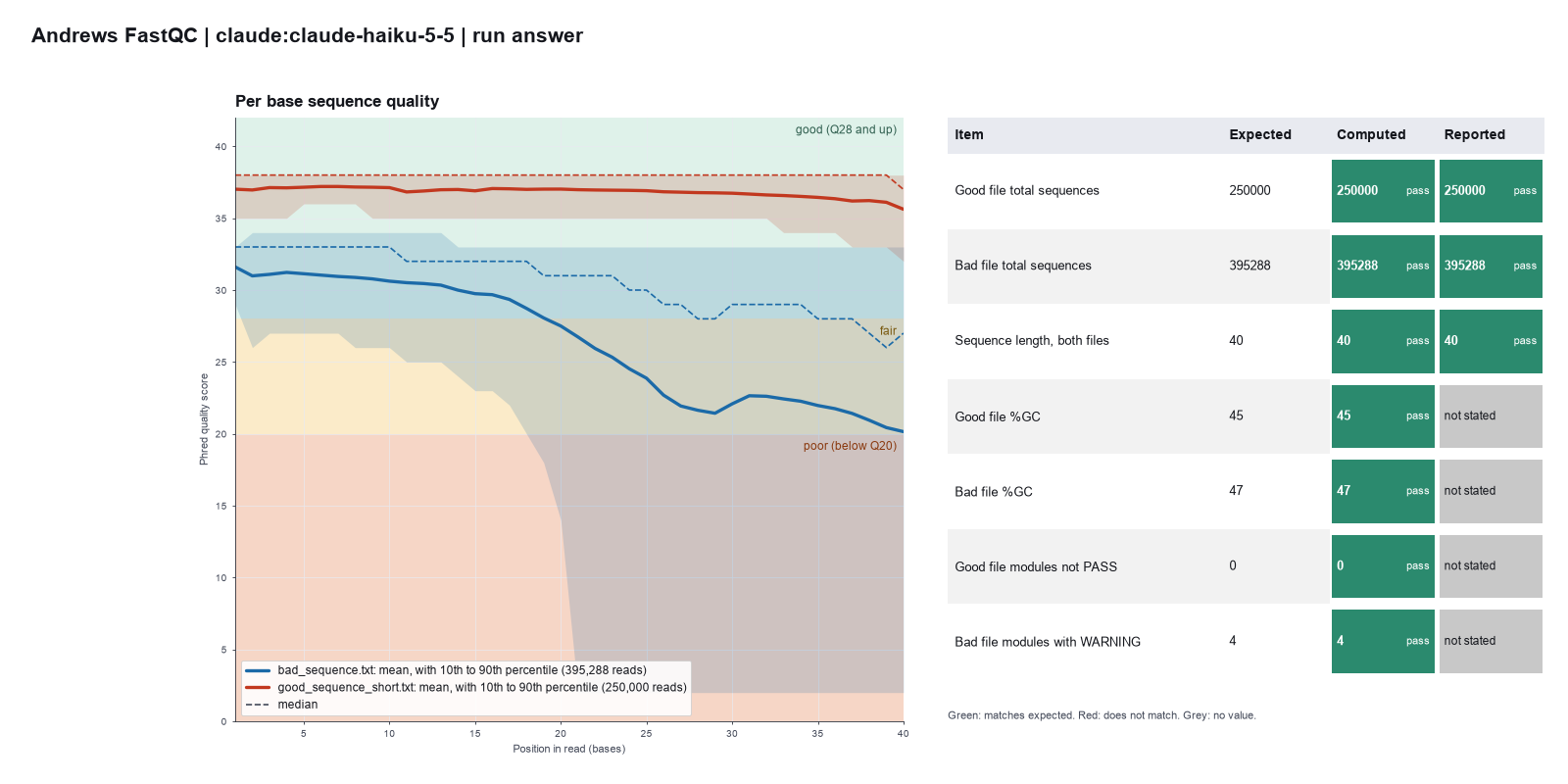
Run facts
| Model | claude-haiku-5-5 through the Anthropic service |
| Date | 2026-10-09 10:08:57 UTC |
| End of run | the model gave a final answer |
| Time | 127 s |
| Requests to the model | 9 |
| Tokensunits of text that the model read and wrote | 22 input, 13458 output, 200933 cache read, 45261 cache write |
| Cost estimate | $0.01 at list price, from the token counts |
| Tool calls | 15 (2 failed) |
| Adapters | fastqc 0.1.2, program 0.13.0 |
| Session | 20261009-050856-3477 |
Code hash of each step (4)
| Step | Tool | Program version | Code hash |
|---|---|---|---|
| n1 | run_fastqc | 0.13.0 | 0d9ef3b14ab4 |
| n2 | run_fastqc | 0.13.0 | 0d9ef3b14ab4 |
| n3 | read_modules | 0.13.0 | 3623112078f9 |
| n4 | read_modules | 0.13.0 | 3623112078f9 |
The code hash is a fingerprint of the adapter name, the adapter version, the tool and its definition in the adapter. If one of these changes, the hash changes.
qwen3:8b · local model through Ollama 7 of 7 values match, 3 of 3 correct in the final answer
The session
This is the session as the scientist sees it, in order. Decision cards show the answer that the script gave and where that answer comes from. Each step shows the program, its version, the input file hash and the outputs. Click a line to see more.
setup The decision record starts with these values. A script set them before the first message, from the answers that we wrote before the run.
- Quality score encoding: phred64Source in the tutorial or test suite: Both example reports give the encoding as Illumina 1.5. That encoding uses Phred quality scores with an offset of 64. FastQC finds the encoding from the file.
- What to do with a module that fails: decide_laterSource in the tutorial or test suite: Not in the documentation. FastQC only reports. Trimming or exclusion of reads is a separate decision for the scientist.
harness note A note from the harness to the model. The scientist did not write it.
- Setup values:
Method:
- Quality score encoding (encoding): phred64
- What to do with a file that has a FAIL module (action_on_fail): decide_later
The harness fills these values into your tool calls automatically. If you give a different value, the harness logs a deviation and shows it to the scientist.
- Mode is now watch: you run the steps.
run_fastqc (adapter fastqc).step n1 run_fastqc adapter fastqc 0.1.2, FastQC 0.13.0
250000 reads of length 40. 11 PASS, 0 WARN, 0 FAIL.
Decisions applied: Quality score encoding = phred64.
Input file: {data}/andrews-fastqc/good_sequence_short.txt SHA-256 56d49e766f2f.
Outputs: fastqc.log (e3b0c44298fc), good_sequence_short_fastqc.html (0b07422b1d44), good_sequence_short_fastqc.zip (032b9ab43c3e), error.png (b9c7d86bf2dd), fastqc_icon.png (e63253011f67), tick.png (e9ed21a3f0e4), warning.png (24e92cafbeb0), adapter_content.png (4d2a7960f4b3), adapter_content.svg (4ccc06886ca2), duplication_levels.png (cc2b3b82b001), duplication_levels.svg (f0d578574842), per_base_n_content.png (5e6f8aee4812), per_base_n_content.svg (b8f9aaa83685), per_base_quality.png (92d300eb7b2d), per_base_quality.svg (8019a71e1240), per_base_sequence_content.png (59f96206d73f), per_base_sequence_content.svg (9665721cbe9b), per_sequence_gc_content.png (9ce88b427acd), per_sequence_gc_content.svg (dd575a96a8c2), per_sequence_quality.png (98e42628646d), per_sequence_quality.svg (52e215f579fa), per_tile_quality.png (6c811ad94097), per_tile_quality.svg (cf8389ba7c4c), sequence_length_distribution.png (9c96e93f04cc), sequence_length_distribution.svg (c6d50861834a), fastqc.fo (a1887a931de0), fastqc_data.txt (0908e6471b79), fastqc_report.html (0b07422b1d44), summary.txt (a9dbec8f9c1a).
Arguments
| encoding | phred64 |
| path | {data}/andrews-fastqc/good_sequence_short.txt |
Tool output
data_file={work}/run_fastqc-1/report/good_sequence_short_fastqc/fastqc_data.txt
html_report={work}/run_fastqc-1/report/good_sequence_short_fastqc.html
module_basic_statistics=PASS
filename=good_sequence_short.txt
file_type=Conventional base calls
encoding=Illumina 1.5
total_sequences=250000
total_bases=10 Mbp
sequence_length=40
mean_length=40
median_length=40
gc_percent=45
module_per_base_sequence_quality=PASS
module_per_tile_sequence_quality=PASS
module_per_sequence_quality_scores=PASS
module_per_base_sequence_content=PASS
module_per_sequence_gc_content=PASS
module_per_base_n_content=PASS
module_sequence_length_distribution=PASS
module_sequence_duplication_levels=PASS
module_overrepresented_sequences=PASS
module_adapter_content=PASS
n_pass=11
n_warn=0
n_fail=0
fail_modules=none
warn_modules=none
run_fastqc (adapter fastqc).step n2 run_fastqc adapter fastqc 0.1.2, FastQC 0.13.0
395288 reads of length 40. 5 PASS, 4 WARN, 2 FAIL.
Decisions applied: Quality score encoding = phred64.
Input file: {data}/andrews-fastqc/bad_sequence.txt SHA-256 6a13706bf7bf.
Outputs: fastqc.log (e3b0c44298fc), bad_sequence_fastqc.html (5afb979bf848), bad_sequence_fastqc.zip (e9463303b143), error.png (b9c7d86bf2dd), fastqc_icon.png (e63253011f67), tick.png (e9ed21a3f0e4), warning.png (24e92cafbeb0), adapter_content.png (236e5fea9f51), adapter_content.svg (3530c4e8f96c), duplication_levels.png (457b031dd3cc), duplication_levels.svg (5472bcbe30c6), per_base_n_content.png (d5d90f5851f0), per_base_n_content.svg (02b9c8384f92), per_base_quality.png (9d47380d0007), per_base_quality.svg (c04130635782), per_base_sequence_content.png (98322a251f0d), per_base_sequence_content.svg (95e7b0097d6c), per_sequence_gc_content.png (f7b3efee2b42), per_sequence_gc_content.svg (9f9c4349defa), per_sequence_quality.png (e034e336f021), per_sequence_quality.svg (57549aba1d53), per_tile_quality.png (21acc1f99ab1), per_tile_quality.svg (de9e6d2ada9e), sequence_length_distribution.png (2f212f6a9dd6), sequence_length_distribution.svg (18d5deaf297c), fastqc.fo (8e420d400f6b), fastqc_data.txt (353552e3b3a1), fastqc_report.html (5afb979bf848), summary.txt (38efb7e96366).
Arguments
| encoding | phred64 |
| path | {data}/andrews-fastqc/bad_sequence.txt |
Tool output
data_file={work}/run_fastqc-2/report/bad_sequence_fastqc/fastqc_data.txt
html_report={work}/run_fastqc-2/report/bad_sequence_fastqc.html
module_basic_statistics=PASS
filename=bad_sequence.txt
file_type=Conventional base calls
encoding=Illumina 1.5
total_sequences=395288
total_bases=15.8 Mbp
sequence_length=40
mean_length=40
median_length=40
gc_percent=47
module_per_base_sequence_quality=FAIL
module_per_tile_sequence_quality=FAIL
module_per_sequence_quality_scores=PASS
module_per_base_sequence_content=WARN
module_per_sequence_gc_content=WARN
module_per_base_n_content=PASS
module_sequence_length_distribution=PASS
module_sequence_duplication_levels=WARN
module_overrepresented_sequences=WARN
module_adapter_content=PASS
n_pass=5
n_warn=4
n_fail=2
fail_modules=Per base sequence quality; Per tile sequence quality
warn_modules=Per base sequence content; Per sequence GC content; Sequence Duplication Levels; Overrepresented sequences
Model The model writes its answer. The claim check reads it. See the final answer.
The final answer
The model wrote this answer. The harness shows it to the scientist after the review.
The good_sequence_short.txt file has 250,000 reads of length 40. The bad_sequence.txt file has 395,288 reads of length 40. The bad_sequence.txt file has modules that are FAIL or WARN, which indicates potential issues with the data quality. The file would not be trusted due to the FAIL modules, which suggest problems with the base sequence quality and per tile sequence quality.
Settings and step results that the answer does not mention. The harness adds them.
Settings used, from the decision record: Quality score encoding: phred64.
Checks
Review findings
The review recorded 4 findings. A rule finding comes from a fixed check in the harness. A referee finding comes from a second model that reads the record. The harness shows the findings to the scientist with the final answer. The record does not mark a finding as fixed. Thus a finding from an early review round can apply to a draft that the model corrected later.
| Severity | From | Finding | Shown with the final answer |
|---|---|---|---|
| info | ruletext_style | The answer breaks the text rules (ASD-STE100) in 2 places. Sentence 3 uses "indicates". Use "shows". Sentence 4 uses the passive voice: "be trusted". Use the active voice. | yes |
| info | referee model | The report correctly states the number of reads and read length for both files. | yes |
| info | referee model | The report correctly identifies the FAIL and WARN modules in the bad_sequence.txt file. | yes |
| warning | referee model | The report should clarify that FAIL and WARN statuses are not definitive indicators of data quality issues and are context-dependent. | yes |
Numbers in the answer
The last claim check read 6 numbers in the answer. 4 numbers match a logged result. 0 numbers have no source in the record.
Numbers that do not match a logged result (2)
- calculated from numbers in the record: The bad_sequence.txt file has modules that are FAIL or WARN, which indicates potential issues with the data quality.
- calculated from numbers in the record: The file would not be trusted due to the FAIL modules, which suggest problems with the base sequence quality and per tile sequence quality.
Deviations
The model did not try to change a choice of the scientist.
Failed tool calls
No tool call failed.
Data integrity
Each data file has the same SHA-256 hash now as at the time of the step that read it. Where the download script (fetch.sh) gives a hash, the file also has that hash. The run did not change the data.
| File | SHA-256 | Fetched data | Steps with this hash |
|---|---|---|---|
{data}/andrews-fastqc/good_sequence_short.txt37.7 MB | 56d49e766f2f | same as the hash in the download script (fetch.sh) | n1 |
{data}/andrews-fastqc/bad_sequence.txt60.3 MB | 6a13706bf7bf | same as the hash in the download script (fetch.sh) | n2 |
A SHA-256 hash is a fingerprint of the file contents. If one byte of the file changes, the hash changes. The table shows the first 12 characters.
How to repeat it
Get the data. The script downloads the files and checks their SHA-256 hashes where it lists them.
CUVETTE_DATA={data} bash bench/papers/andrews-fastqc/fetch.shRun the same case with Cuvette. The script gives the same answers from bench/papers/andrews-fastqc/bench.yaml.
cuvette bench papers --papers andrews-fastqc --models ollama:qwen3:8b
Repeat each step by hand in the program. For each step, the harness records a manual route: the menu path or the code that gives the same result. This list does not include comparison runs.
run_fastqc(step n1)Run: fastqc --extract --outdir <folder> [--phred64] <reads file>. In the FastQC window:
<reads file>
{data}/andrews-fastqc/good_sequence_short.txt- --phred64 =
phred64 - Warning: If you keep the default auto, you get a different result.
The manual route that the harness recorded
/bin/sh {other volume}/tools/overnight/checkout/catalog/fastqc/scripts/run_fastqc.sh /opt/homebrew/bin/fastqc {data}/andrews-fastqc/good_sequence_short.txt phred64The manual route gives the same numbers. An automatic test in Cuvette checks this.
run_fastqc(step n2)Run: fastqc --extract --outdir <folder> [--phred64] <reads file>. In the FastQC window:
<reads file>
{data}/andrews-fastqc/bad_sequence.txt- --phred64 =
phred64 - Warning: If you keep the default auto, you get a different result.
The manual route that the harness recorded
/bin/sh {other volume}/tools/overnight/checkout/catalog/fastqc/scripts/run_fastqc.sh /opt/homebrew/bin/fastqc {data}/andrews-fastqc/bad_sequence.txt phred64The manual route gives the same numbers. An automatic test in Cuvette checks this.
Figure
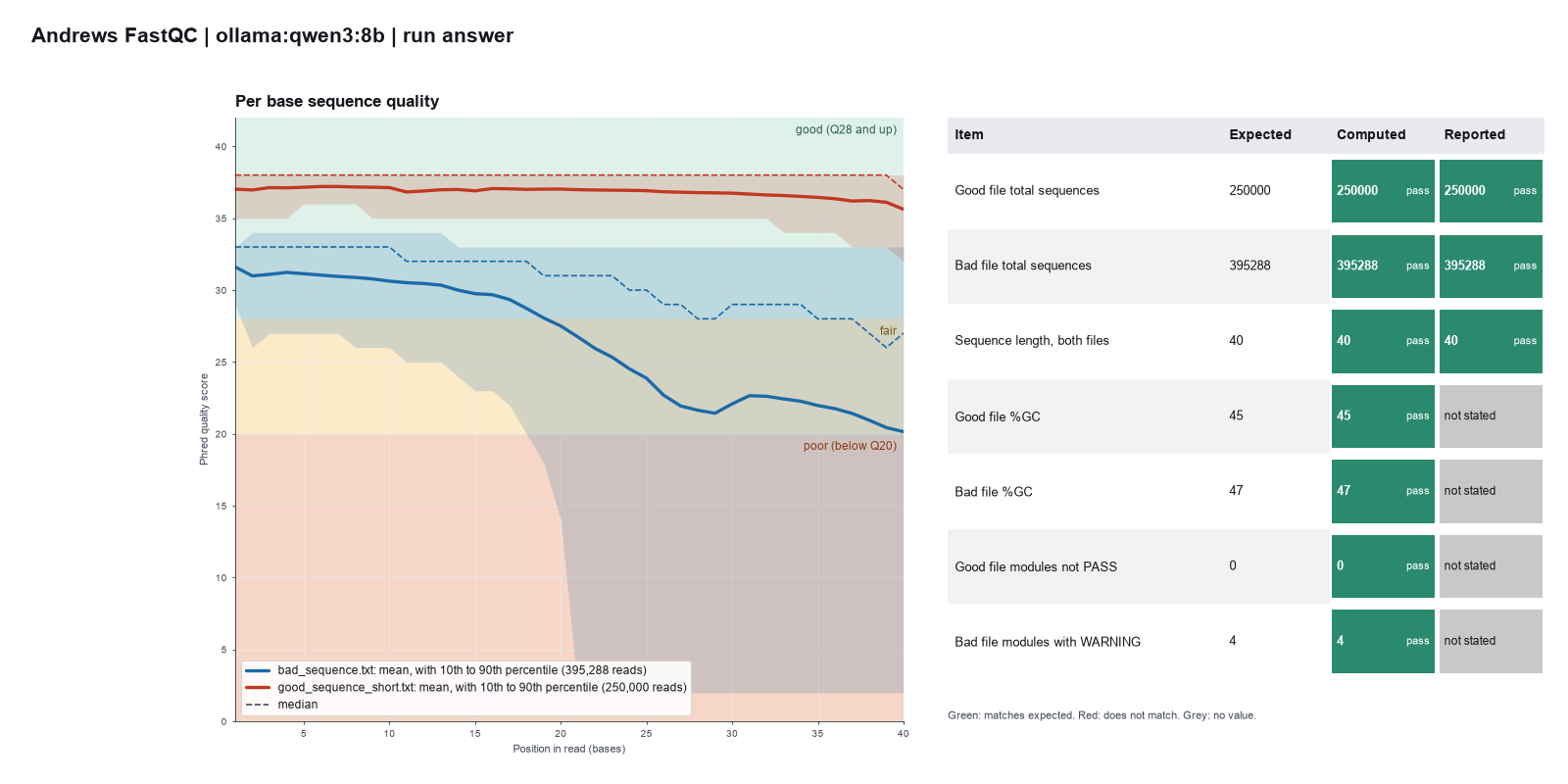
Run facts
| Model | qwen3:8b through Ollama, on our own computer |
| Date | 2026-10-09 08:08:20 UTC |
| End of run | the model gave a final answer |
| Time | 55 s |
| Requests to the model | 3 |
| Tokensunits of text that the model read and wrote | 17953 input, 184 output, 0 cache read, 0 cache write |
| Cost estimate | none: the model runs on our own computer |
| Tool calls | 2 (0 failed) |
| Adapters | fastqc 0.1.2, program 0.13.0 |
| Session | 20261009-030819-319c |
Code hash of each step (2)
| Step | Tool | Program version | Code hash |
|---|---|---|---|
| n1 | run_fastqc | 0.13.0 | 0d9ef3b14ab4 |
| n2 | run_fastqc | 0.13.0 | 0d9ef3b14ab4 |
The code hash is a fingerprint of the adapter name, the adapter version, the tool and its definition in the adapter. If one of these changes, the hash changes.