Validation / Papers / Quinlan 2010
Quinlan and Hall 2010: BEDTools
How to read this page
In this validation, a script plays the scientist. It gives the answers that we wrote before the run, from the methods of the paper. The run is one sample: another run can give different steps and numbers. The model is the AI. The harness is Cuvette, the software around the model: it runs the programs and records each step. A tool call is a request from the model to run one program step. The session record is the log of each message and each step. The claim check is a script that finds each number of the final answer in the step results. The review is a set of fixed rule checks plus a second AI model, the referee, that reads the record. A deviation is a request from the model for a setting that differs from the choice of the scientist. Each Claude model did 3 runs of this paper. This page shows run 3 of each Claude model and the one run of qwen3:8b. The table of values says how many of the Claude runs match.
Opus: 4 of 4 values match, 3 of 3 correct in the final answer. All 3 runs: 4 of 4 values match. Sonnet: 4 of 4 values match, 3 of 3 correct in the final answer. All 3 runs: 4 of 4 values match. Haiku: 4 of 4 values match, 3 of 3 correct in the final answer. All 3 runs: 4 of 4 values match. qwen3:8b: 4 of 4 values match, 3 of 3 correct in the final answer.
The figure in the paper and in the run
As published
The paper is an application note of two pages. It describes the tools (intersect, merge and others) and gives no numeric result for these files.
Reproduced in Cuvette
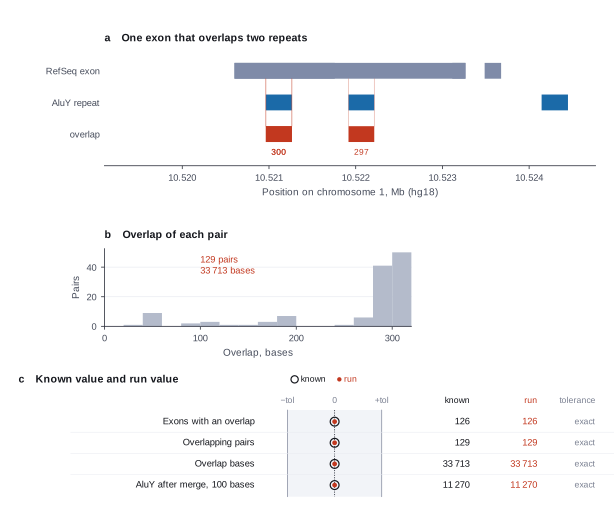
The paper
Quinlan AR, Hall IM. BEDTools: a flexible suite of utilities for comparing genomic features. Bioinformatics 26(6):841-842 (2010). doi:10.1093/bioinformatics/btq033
Related sources:
- The data folder of the bedtools2 source repository. Source of the exon and AluY files. link
What it measured
The paper describes bedtools, a set of programs that compare sets of genome intervals. The main operations find overlaps between two sets and merge intervals that lie near each other. The paper is a two-page application note and gives no numbers for these files. We use two example files from the bedtools repository. One file holds RefSeq exons and the other holds AluY repeats on human chromosome 1.
Data
Files refseq.chr1.exons.bed and aluY.chr1.bed from the bedtools2 source repository. Size: 0.6 MB compressed, 3.2 MB as text. 43424 exons and 11628 AluY repeats..
License: The bedtools2 repository is under the MIT License. The files are public genome annotation with no personal data.
The instruction
A script sent this message as the scientist. The file paths point to the fetched data.
The same request in the words of the paper's method:
I have RefSeq exons and AluY repeats on human chromosome 1, both on genome build hg18. How many exons overlap a repeat, and how many bases overlap in total? Then merge the repeats that lie within 100 bases of each other. How many intervals remain?
Basis: The intersect and merge operations that the paper describes. The question about exons and repeats is our choice, because the paper has no worked example on these files.
Results
Match: a number in the session record is inside the tolerance of the known value. In the final answer: the model also stated the value in its final answer. For a Claude model, each cell shows the run that this page shows. If the three runs differ, the cell also says in how many runs the value matches.
| Value | Known value | Tolerance | Opus | Sonnet | Haiku | qwen3:8b |
|---|---|---|---|---|---|---|
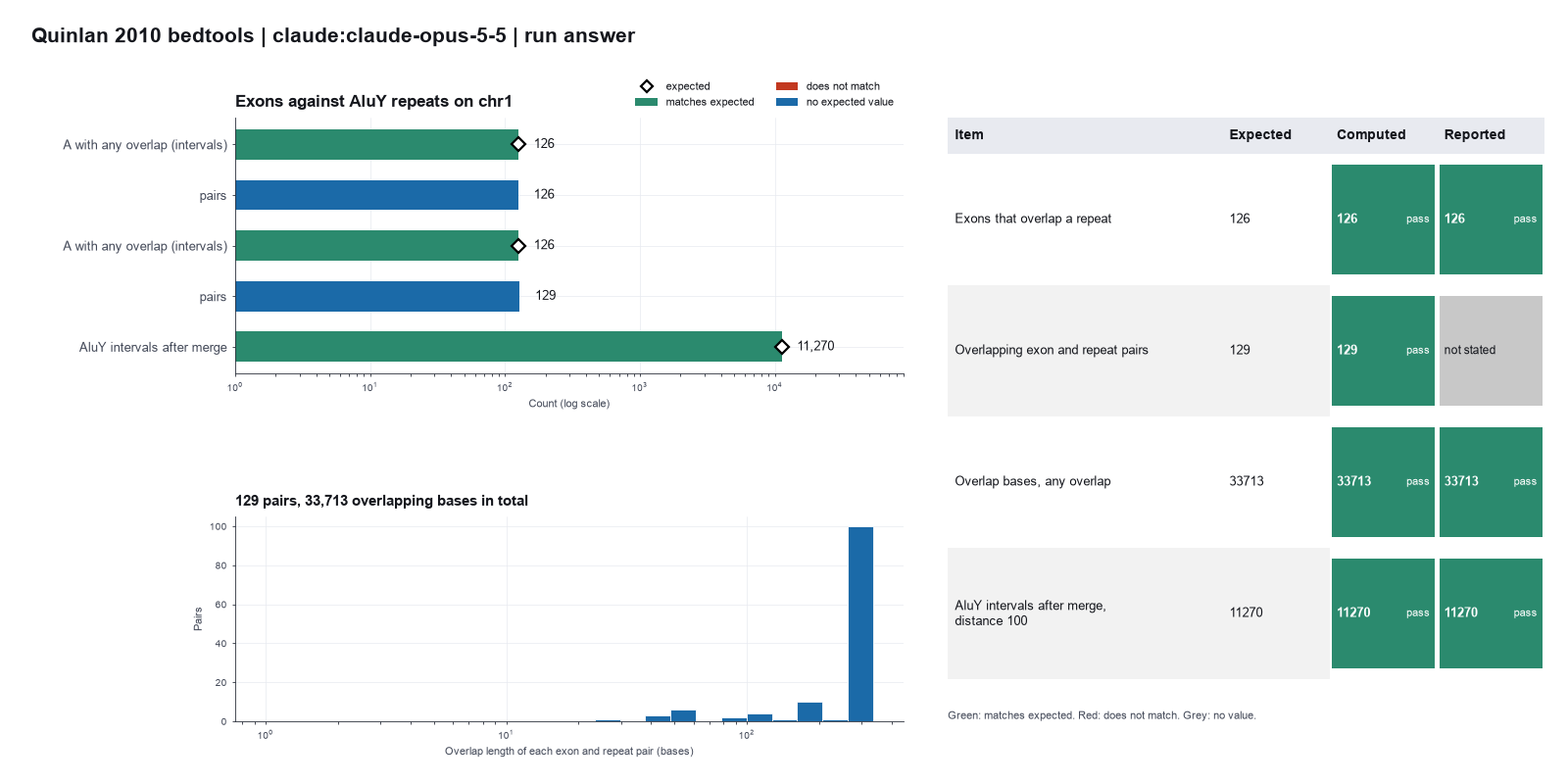
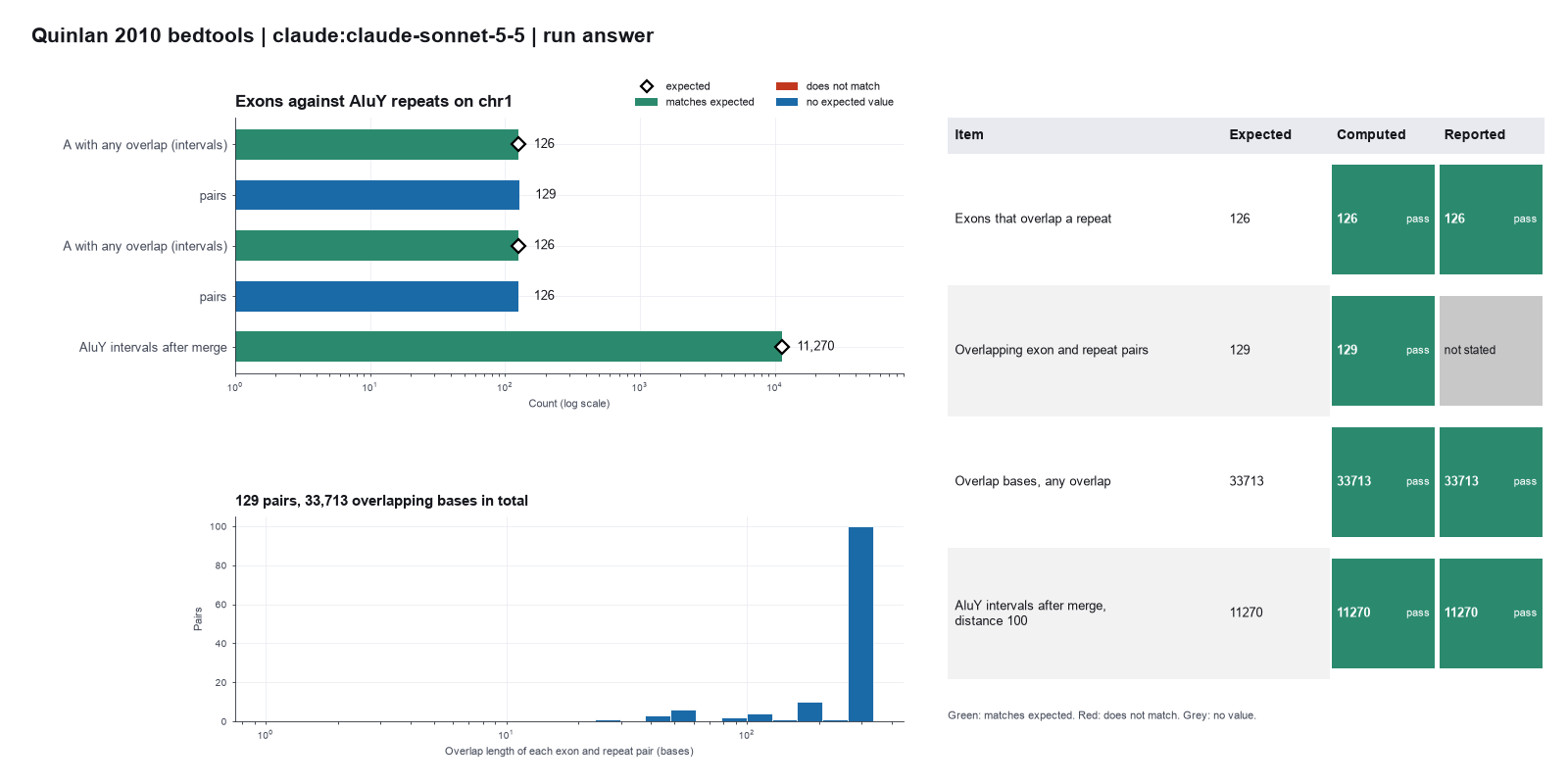
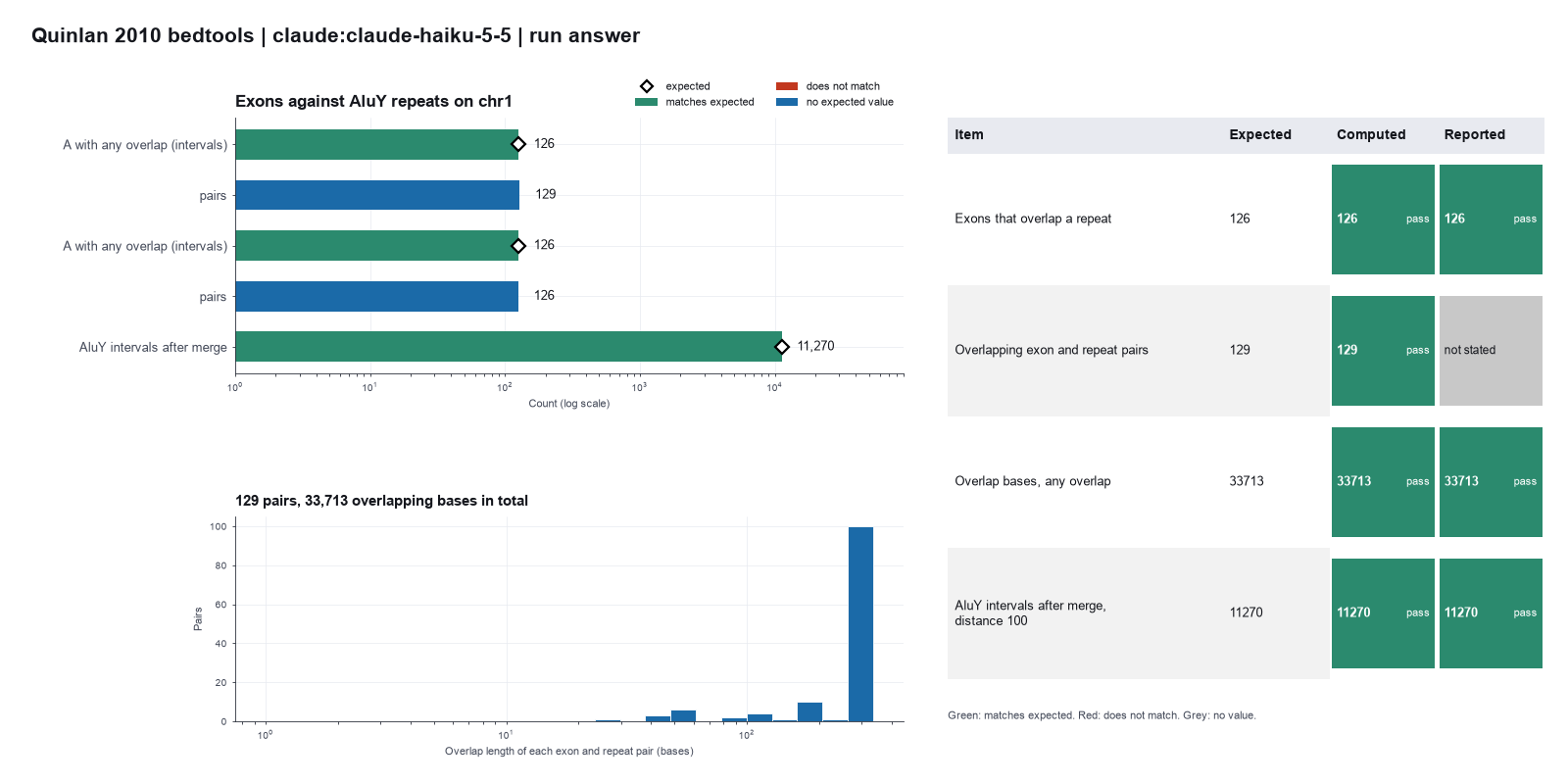
exons_with_overlapExons that overlap a repeatSource of the known valueWe calculated it with bedtools 2.31.1 intersect -uNot in the paper. The paper gives no numbers for these files. | 126 | exact | 126 matchIn the final answer: yes (126)Log: n1 intersect_intervals metrics.n_result, entry 11; the final answer, entry 32 | 126 matchIn the final answer: yes (126)Log: n1 intersect_intervals metrics.n_a_with_overlap, entry 18; the final answer, entry 47 | 126 matchIn the final answer: yes (126)Log: n1 intersect_intervals metrics.n_a_with_overlap, entry 14; the final answer, entry 49 | 126 matchIn the final answer: yes (126)Log: n1 intersect_intervals metrics.n_a_with_overlap, entry 10; the final answer, entry 28 |
overlapping_pairsOverlapping exon and repeat pairsSource of the known valueWe calculated it with bedtools 2.31.1 intersect -woNot in the paper. There are 129 pairs but 126 exons, because one exon can overlap more than one repeat. | 129 | exact | 129 matchNot asked in the questionLog: n2 intersect_intervals metrics.n_result, entry 14 | 129 matchNot asked in the questionLog: n1 intersect_intervals metrics.n_result, entry 18 | 129 matchNot asked in the questionLog: n1 intersect_intervals metrics.n_result, entry 14 | 129 matchNot asked in the questionLog: n1 intersect_intervals metrics.n_result, entry 10 |
overlap_basesOverlap bases, any overlapSource of the known valueWe calculated it with bedtools 2.31.1 intersect -wo, sum of the last columnNot in the paper. We checked the sum with awk. | 33713 | exact | 33713 matchIn the final answer: yes (33713)Log: n2 intersect_intervals metrics.overlap_bases, entry 14; the final answer, entry 32 | 33713 matchIn the final answer: yes (33713)Log: n1 intersect_intervals metrics.overlap_bases, entry 18; the final answer, entry 47 | 33713 matchIn the final answer: yes (33713)Log: n1 intersect_intervals metrics.overlap_bases, entry 14; the final answer, entry 49 | 33713 matchIn the final answer: yes (33713)Log: n1 intersect_intervals metrics.overlap_bases, entry 10; the final answer, entry 28 |
merged_intervalsAluY intervals after merge, distance 100Source of the known valueWe calculated it with bedtools 2.31.1 merge -d 100 on sorted inputNot in the paper. The 11628 AluY repeats become 11270 intervals. | 11270 | exact | 11270 matchIn the final answer: yes (11270)Log: n3 merge_intervals metrics.n_merged, entry 17; the final answer, entry 32 | 11270 matchIn the final answer: yes (11270)Log: n3 merge_intervals metrics.n_merged, entry 24; the final answer, entry 47 | 11270 matchIn the final answer: yes (11270)Log: n3 merge_intervals metrics.n_merged, entry 25; the final answer, entry 49 | 11270 matchIn the final answer: yes (11270)Log: n2 merge_intervals metrics.n_merged, entry 20; the final answer, entry 28 |
Session records
Session record, Opus, run 3 of 3
Every message, decision, step and result of this run, one JSON object for each log entry.
Session record, Sonnet, run 3 of 3
Every message, decision, step and result of this run, one JSON object for each log entry.
Session record, Haiku, run 3 of 3
Every message, decision, step and result of this run, one JSON object for each log entry.
Session record, qwen3:8b
Every message, decision, step and result of this run, one JSON object for each log entry.
Opus · claude-opus-5-5 · run 3 of 3 shown 4 of 4 values match, 3 of 3 correct in the final answer
The session
This is the session as the scientist sees it, in order. Decision cards show the answer that the script gave and where that answer comes from. Each step shows the program, its version, the input file hash and the outputs. Click a line to see more.
setup The decision record starts with these values. A script set them before the first message, from the answers that we wrote before the run.
- Genome build: hg18Source in the tutorial or test suite: Not in the paper. The repository files use hg18 coordinates. Both files must use the same build.
- Minimum overlap as a fraction of the exon: 0Source in the tutorial or test suite: Not in the paper. This is the bedtools intersect default.
- Minimum overlap as a fraction of the repeat: 0Source in the tutorial or test suite: Not in the paper. This is the bedtools intersect default.
- Require a reciprocal fraction: falseSource in the tutorial or test suite: Not in the paper. This is the bedtools intersect default.
- Strand rule: anySource in the tutorial or test suite: Not in the paper. This is the bedtools intersect default. Both files have a strand column.
- Merge distance: 100Source in the tutorial or test suite: Not in the paper. We set the distance. The bedtools merge default is 0.
harness note A note from the harness to the model. The scientist did not write it.
- Setup values:
Data:
- Reference genome build (genome_build): hg18
Overlap rule:
- Smallest overlap as a fraction of A (min_fraction_a): 0
- Smallest overlap as a fraction of B (min_fraction_b): 0
- Require the same fraction for A and for B (reciprocal): false
- Strand rule (strand): any
Merge:
- Largest gap to merge across (merge_distance): 100
The harness fills these values into your tool calls automatically. If you give a different value, the harness logs a deviation and shows it to the scientist.
- Mode is now watch: you run the steps.
Model thinking, summary: I need to address questions 1 and 3: finding the exon intersection count, the base overlap, and merging with a 100bp distance. Strand doesn't matter here, so I'll proceed by running the necessary calls in parallel without needing to check for a strand column first.
Model
I will count the exons with an overlap and the overlapping bases, then merge the repeats. The exon file is A and the repeat file is B.
intersect_intervals (adapter bedtools).step n1 intersect_intervals adapter bedtools 0.1.1, bedtools 2.31.1
126 lines. 126 A intervals overlap.
Decisions applied: Minimum overlap as a fraction of the exon = 0; Minimum overlap as a fraction of the repeat = 0; Require a reciprocal fraction = false; Strand rule = any.
Input files: {data}/quinlan2010-bedtools/refseq.chr1.exons.bed SHA-256 00105bd81f04; {data}/quinlan2010-bedtools/aluY.chr1.bed SHA-256 1d7af795ec35.
Outputs: bed (370f10a746c0).
Arguments
| a | {data}/quinlan2010-bedtools/refseq.chr1.exons.bed |
| b | {data}/quinlan2010-bedtools/aluY.chr1.bed |
| report | unique_a |
| min_fraction_a | 0 |
| min_fraction_b | 0 |
| reciprocal | false |
| strand | any |
Tool output
bed={work}/intersect_intervals-1/bed.bed
report=unique_a
n_a=43424
n_b=11628
n_result=126
n_a_with_overlap=126
intersect_intervals (adapter bedtools).step n2 intersect_intervals adapter bedtools 0.1.1, bedtools 2.31.1
129 lines. 126 A intervals overlap.
Decisions applied: Minimum overlap as a fraction of the exon = 0; Minimum overlap as a fraction of the repeat = 0; Require a reciprocal fraction = false; Strand rule = any.
Input files: {data}/quinlan2010-bedtools/refseq.chr1.exons.bed SHA-256 00105bd81f04; {data}/quinlan2010-bedtools/aluY.chr1.bed SHA-256 1d7af795ec35.
Outputs: bed (fb43e5c485f8).
Arguments
| a | {data}/quinlan2010-bedtools/refseq.chr1.exons.bed |
| b | {data}/quinlan2010-bedtools/aluY.chr1.bed |
| report | pairs |
| min_fraction_a | 0 |
| min_fraction_b | 0 |
| reciprocal | false |
| strand | any |
Tool output
bed={work}/intersect_intervals-2/bed.bed
report=pairs
n_a=43424
n_b=11628
n_result=129
overlap_bases=33713
n_a_with_overlap=126
merge_intervals (adapter bedtools).step n3 merge_intervals adapter bedtools 0.1.1, bedtools 2.31.1
11628 intervals merged into 11270 (3258788 bases).
Decisions applied: Strand rule = any; Merge distance = 100.
Input file: {data}/quinlan2010-bedtools/aluY.chr1.bed SHA-256 1d7af795ec35.
Outputs: bed (7115318c792f).
Arguments
| path | {data}/quinlan2010-bedtools/aluY.chr1.bed |
| distance | 100 |
| strand | any |
Tool output
bed={work}/merge_intervals-1/bed.bed
n_input=11628
n_merged=11270
merged_bases=3258788
Model thinking, summary: Summing across pairs gives a total overlap of 33713 bases, though I should flag that if repeats overlap each other within an exon, those bases could get double-counted.
Model Answer draft 1. The claim check and the review read it.
Answers
- 126 exons overlap at least one AluY repeat. The overlapping bases total 33,713 bases, summed over all exon–repeat pairs.
- The question list has no question 2, so I did not do one.
- After you merge AluY repeats that lie within 100 bases of each other, 11,270 intervals remain. There were 11,628 repeats before the merge.
What I did
- File A: the exons,
{data}/quinlan2010-bedtools/refseq.chr1.exons.bed(43,424 intervals). - File B: the AluY repeats,
{data}/quinlan2010-bedtools/aluY.chr1.bed(11,628 intervals). - Genome build: you gave hg18 for both files. The files do not state a build themselves.
- Overlap rule for both intersect steps: the default of 1 base. The fraction of A is 0, the fraction of B is 0, the overlap is not reciprocal and the strand rule is "any".
Where each number comes from
- The
intersect_intervalstool with report unique_a gave 126. This counts exons (A intervals), and each exon counts one time only. - The
intersect_intervalstool with report pairs gave 129 exon–repeat pairs and 33,713 overlapping bases. Three more pairs than exons means a few exons overlap more than one repeat. - The
merge_intervalstool with a merge distance of 100 bases and strand "any" gave 11,270 intervals. The merged intervals cover 3,258,788 bases. The tool sorted the file before the merge.
What is uncertain
- The 33,713 bases are a sum over pairs. If two repeats overlap each other inside one exon, the shared bases count twice. So the number of distinct exon bases that repeats cover can be a little lower. The coverage tool can measure that number if you need it.
- An overlap shows only that an exon and a repeat share bases. It does not show a function.
Output files
- Exons with an overlap:
{work}/intersect_intervals-1/bed.bed - Exon–repeat pairs:
.../work/intersect_intervals-2/bed.bed - Merged repeats:
.../work/merge_intervals-1/bed.bed
Nothing waits for you. All setup values (hg18, default overlap rule, strand "any", merge distance 100) came from your record.
review The review sent the answer back to the model before the scientist saw it.
- 2 numbers in the answer match no logged tool result: 20261009, 80612. Run the tool that measures each number, or remove the number, or say how you derived it from logged results.
Fix these problems. Then give the answer again.
Model The model writes its answer. The claim check reads it. See the final answer.
The final answer
The model wrote this answer. The harness shows it to the scientist after the review.
Answers
- 126 exons overlap at least one AluY repeat. The overlapping bases total 33,713 bases, summed over all exon–repeat pairs.
- The question list has no question 2, so I did not do one.
- After you merge AluY repeats that lie within 100 bases of each other, 11,270 intervals remain. There were 11,628 repeats before the merge.
What I did
- File A: the exons,
{data}/quinlan2010-bedtools/refseq.chr1.exons.bed(43,424 intervals). - File B: the AluY repeats,
{data}/quinlan2010-bedtools/aluY.chr1.bed(11,628 intervals). - Genome build: you gave hg18 for both files. The files do not state a build themselves.
- Overlap rule for both intersect steps: the default of 1 base. The fraction of A is 0, the fraction of B is 0, the overlap is not reciprocal and the strand rule is "any".
Where each number comes from
- The
intersect_intervalstool with report unique_a gave 126. This counts exons (A intervals), and each exon counts one time only. - The
intersect_intervalstool with report pairs gave 129 exon–repeat pairs and 33,713 overlapping bases. Three more pairs than exons means a few exons overlap more than one repeat. - The
merge_intervalstool with a merge distance of 100 bases and strand "any" gave 11,270 intervals. The merged intervals cover 3,258,788 bases. The tool sorted the file before the merge.
What is uncertain
- The 33,713 bases are a sum over pairs. If two repeats overlap each other inside one exon, the shared bases count twice. So the number of distinct exon bases that repeats cover can be a little lower. The coverage tool can measure that number if you need it.
- An overlap shows only that an exon and a repeat share bases. It does not show a function.
Output files The files are in the session work folder of this analysis:
- Exons with an overlap:
intersect_intervals-1/bed.bed - Exon–repeat pairs:
intersect_intervals-2/bed.bed - Merged repeats:
merge_intervals-1/bed.bed
Nothing waits for you. All setup values (hg18, default overlap rule, strand "any", merge distance 100) came from your record.
Settings and step results that the answer does not mention. The harness adds them.
Settings used, from the decision record: Smallest overlap as a fraction of A: 0 · Smallest overlap as a fraction of B: 0 · Require the same fraction for A and for B: false · Strand rule: any · Largest gap to merge across: 100.
Checks
Review findings
The review recorded 2 findings. A rule finding comes from a fixed check in the harness. A referee finding comes from a second model that reads the record. The harness shows the findings to the scientist with the final answer. The record does not mark a finding as fixed. Thus a finding from an early review round can apply to a draft that the model corrected later.
| Severity | From | Finding | Shown with the final answer |
|---|---|---|---|
| info | referee model | The merged intervals span 3,258,788 bases. A merge with a distance of 100 joins repeats across gaps of up to 100 bases, so this span includes gap bases that no repeat covers. The answer must not present this number as the number of repeat bases. | yes |
| info | referee model | The 126 counts A intervals in the RefSeq exon file. Such files can list the same exon one time for each transcript. Thus 126 can be higher than the number of distinct exons. The answer calls the 126 "exons" and does not say that duplicate intervals were not removed. | yes |
Numbers in the answer
The last claim check read 12 numbers in the answer. 12 numbers match a logged result. 0 numbers have no source in the record.
Deviations
The model did not try to change a choice of the scientist.
Failed tool calls
No tool call failed.
Data integrity
Each data file has the same SHA-256 hash now as at the time of the step that read it. The run did not change the data.
| File | SHA-256 | Fetched data | Steps with this hash |
|---|---|---|---|
{data}/quinlan2010-bedtools/refseq.chr1.exons.bed2.7 MB | 00105bd81f04 | the download script (fetch.sh) has no hash for this file | n1, n2 |
{data}/quinlan2010-bedtools/aluY.chr1.bed410.0 KB | 1d7af795ec35 | the download script (fetch.sh) has no hash for this file | n1, n2, n3 |
A SHA-256 hash is a fingerprint of the file contents. If one byte of the file changes, the hash changes. The table shows the first 12 characters.
How to repeat it
Get the data. The script downloads the files and checks their SHA-256 hashes where it lists them.
CUVETTE_DATA={data} bash bench/papers/quinlan2010-bedtools/fetch.shRun the same case with Cuvette. The script gives the same answers from bench/papers/quinlan2010-bedtools/bench.yaml.
cuvette bench papers --papers quinlan2010-bedtools --models claude:claude-opus-5-5
Repeat each step by hand in the program. For each step, the harness records a manual route: the menu path or the code that gives the same result. This list does not include comparison runs.
intersect_intervals(step n1)Run: bedtools intersect -a <A>.bed -b <B>.bed [-f <frac>] [-F <frac>] [-r] [-s | -S] [-wo | -c | -u | -v]
-a
{data}/quinlan2010-bedtools/refseq.chr1.exons.bed-b
{data}/quinlan2010-bedtools/aluY.chr1.bed- -f =
0 - -F =
0 - -r =
false - -s / -S =
any - -wo / -c / -u / -v =
unique_a - Warning: If you keep the default 1e-9, you get a different result.
- Warning: If you keep the default 1e-9, you get a different result.
- Warning: If you keep the default , you get a different result.
The manual route that the harness recorded
/bin/sh {other volume}/tools/overnight/claude-final/catalog/bedtools/scripts/intersect.sh /opt/homebrew/bin/bedtools {work}/intersect_intervals-1/bed.bed {data}/quinlan2010-bedtools/refseq.chr1.exons.bed {data}/quinlan2010-bedtools/aluY.chr1.bed --fa 0 --fb 0 --reciprocal false --strand any --report unique_aThe manual route gives the same numbers. An automatic test in Cuvette checks this.
intersect_intervals(step n2)Run: bedtools intersect -a <A>.bed -b <B>.bed [-f <frac>] [-F <frac>] [-r] [-s | -S] [-wo | -c | -u | -v]
-a
{data}/quinlan2010-bedtools/refseq.chr1.exons.bed-b
{data}/quinlan2010-bedtools/aluY.chr1.bed- -f =
0 - -F =
0 - -r =
false - -s / -S =
any - -wo / -c / -u / -v =
pairs - Warning: If you keep the default 1e-9, you get a different result.
- Warning: If you keep the default 1e-9, you get a different result.
- Warning: If you keep the default , you get a different result.
The manual route that the harness recorded
/bin/sh {other volume}/tools/overnight/claude-final/catalog/bedtools/scripts/intersect.sh /opt/homebrew/bin/bedtools {work}/intersect_intervals-2/bed.bed {data}/quinlan2010-bedtools/refseq.chr1.exons.bed {data}/quinlan2010-bedtools/aluY.chr1.bed --fa 0 --fb 0 --reciprocal false --strand any --report pairsThe manual route gives the same numbers. An automatic test in Cuvette checks this.
merge_intervals(step n3)Run: sort -k1,1 -k2,2n <in>.bed | bedtools merge -i - [-d <gap>] [-s]
-i
{data}/quinlan2010-bedtools/aluY.chr1.bed- -d =
100 - -s =
any - Warning: If you keep the default 0, you get a different result.
The manual route that the harness recorded
/bin/sh {other volume}/tools/overnight/claude-final/catalog/bedtools/scripts/merge.sh /opt/homebrew/bin/bedtools {work}/merge_intervals-1/bed.bed {data}/quinlan2010-bedtools/aluY.chr1.bed --distance 100 --strand anyThe manual route gives the same numbers. An automatic test in Cuvette checks this.
Figure
Run facts
| Model | claude-opus-5-5 through the Anthropic service |
| Date | 2026-10-09 13:06:15 UTC |
| End of run | the model gave a final answer |
| Time | 56 s |
| Requests to the model | 3 |
| Tokensunits of text that the model read and wrote | 10 input, 2999 output, 19998 cache read, 12726 cache write |
| Cost estimate | $0.13 at list price, from the token counts |
| Tool calls | 3 (0 failed) |
| Adapters | bedtools 0.1.1, program 2.31.1 |
| Session | 20261009-080612-c315 |
Code hash of each step (3)
| Step | Tool | Program version | Code hash |
|---|---|---|---|
| n1 | intersect_intervals | 2.31.1 | b8bf0e3ce953 |
| n2 | intersect_intervals | 2.31.1 | b8bf0e3ce953 |
| n3 | merge_intervals | 2.31.1 | df29e9e2f52d |
The code hash is a fingerprint of the adapter name, the adapter version, the tool and its definition in the adapter. If one of these changes, the hash changes.
Sonnet · claude-sonnet-5-5 · run 3 of 3 shown 4 of 4 values match, 3 of 3 correct in the final answer
The session
This is the session as the scientist sees it, in order. Decision cards show the answer that the script gave and where that answer comes from. Each step shows the program, its version, the input file hash and the outputs. Click a line to see more.
setup The decision record starts with these values. A script set them before the first message, from the answers that we wrote before the run.
- Genome build: hg18Source in the tutorial or test suite: Not in the paper. The repository files use hg18 coordinates. Both files must use the same build.
- Minimum overlap as a fraction of the exon: 0Source in the tutorial or test suite: Not in the paper. This is the bedtools intersect default.
- Minimum overlap as a fraction of the repeat: 0Source in the tutorial or test suite: Not in the paper. This is the bedtools intersect default.
- Require a reciprocal fraction: falseSource in the tutorial or test suite: Not in the paper. This is the bedtools intersect default.
- Strand rule: anySource in the tutorial or test suite: Not in the paper. This is the bedtools intersect default. Both files have a strand column.
- Merge distance: 100Source in the tutorial or test suite: Not in the paper. We set the distance. The bedtools merge default is 0.
harness note A note from the harness to the model. The scientist did not write it.
- Setup values:
Data:
- Reference genome build (genome_build): hg18
Overlap rule:
- Smallest overlap as a fraction of A (min_fraction_a): 0
- Smallest overlap as a fraction of B (min_fraction_b): 0
- Require the same fraction for A and for B (reciprocal): false
- Strand rule (strand): any
Merge:
- Largest gap to merge across (merge_distance): 100
The harness fills these values into your tool calls automatically. If you give a different value, the harness logs a deviation and shows it to the scientist.
- Mode is now watch: you run the steps.
intersect-intervals.merge-and-cover.Model thinking, summary: I'm setting up exons as A and repeats as B, then running the pairwise comparison, extracting unique entries from A, and merging the results.
Model
I will run the exon and repeat overlap two ways, with exons as A and repeats as B, and then merge the repeats.
intersect_intervals (adapter bedtools).step n1 intersect_intervals adapter bedtools 0.1.1, bedtools 2.31.1
129 lines. 126 A intervals overlap.
Decisions applied: Minimum overlap as a fraction of the exon = 0; Minimum overlap as a fraction of the repeat = 0; Require a reciprocal fraction = false; Strand rule = any.
Input files: {data}/quinlan2010-bedtools/refseq.chr1.exons.bed SHA-256 00105bd81f04; {data}/quinlan2010-bedtools/aluY.chr1.bed SHA-256 1d7af795ec35.
Outputs: bed (fb43e5c485f8).
Arguments
| a | {data}/quinlan2010-bedtools/refseq.chr1.exons.bed |
| b | {data}/quinlan2010-bedtools/aluY.chr1.bed |
| report | pairs |
| min_fraction_a | 0 |
| min_fraction_b | 0 |
| reciprocal | false |
| strand | any |
Tool output
bed={work}/intersect_intervals-1/bed.bed
report=pairs
n_a=43424
n_b=11628
n_result=129
overlap_bases=33713
n_a_with_overlap=126
intersect_intervals (adapter bedtools).step n2 intersect_intervals adapter bedtools 0.1.1, bedtools 2.31.1
126 lines. 126 A intervals overlap.
Decisions applied: Minimum overlap as a fraction of the exon = 0; Minimum overlap as a fraction of the repeat = 0; Require a reciprocal fraction = false; Strand rule = any.
Input files: {data}/quinlan2010-bedtools/refseq.chr1.exons.bed SHA-256 00105bd81f04; {data}/quinlan2010-bedtools/aluY.chr1.bed SHA-256 1d7af795ec35.
Outputs: bed (370f10a746c0).
Arguments
| a | {data}/quinlan2010-bedtools/refseq.chr1.exons.bed |
| b | {data}/quinlan2010-bedtools/aluY.chr1.bed |
| report | unique_a |
| min_fraction_a | 0 |
| min_fraction_b | 0 |
| reciprocal | false |
| strand | any |
Tool output
bed={work}/intersect_intervals-2/bed.bed
report=unique_a
n_a=43424
n_b=11628
n_result=126
n_a_with_overlap=126
merge_intervals (adapter bedtools).step n3 merge_intervals adapter bedtools 0.1.1, bedtools 2.31.1
11628 intervals merged into 11270 (3258788 bases).
Decisions applied: Strand rule = any; Merge distance = 100.
Input file: {data}/quinlan2010-bedtools/aluY.chr1.bed SHA-256 1d7af795ec35.
Outputs: bed (7115318c792f).
Arguments
| path | {data}/quinlan2010-bedtools/aluY.chr1.bed |
| distance | 100 |
| strand | any |
Tool output
bed={work}/merge_intervals-1/bed.bed
n_input=11628
n_merged=11270
merged_bases=3258788
Model
What I did
- I ran
intersect_intervalswith report "pairs". File A was the exons and file B was the AluY repeats. - I ran
intersect_intervalsagain with report "unique_a" to count the exons. - I ran
merge_intervalson the repeats with a merge distance of 100 bases.
Both files are on chr1. The genome build is hg18, as you set it. The files do not state the build themselves, so I could not check it.
Files
- A (exons):
{data}/quinlan2010-bedtools/refseq.chr1.exons.bed. It has 43,424 intervals. - B (repeats):
{data}/quinlan2010-bedtools/aluY.chr1.bed. It has 11,628 intervals.
Question 1: exon and repeat overlap The overlap rule is the default. That means at least 1 base of overlap, no fraction of A or B, not reciprocal, and any strand.
- Exons that overlap a repeat: 126 exons (A intervals). Report "unique_a" and report "pairs" both gave this number.
- Pairs of exon and repeat: 129. Some exons overlap more than one repeat.
- Total overlapping bases: 33,713. This is the sum over all 129 pairs.
Question 3: merge the repeats The merge distance is 100 bases and the strand rule is any.
- Intervals remaining: 11,270, down from 11,628.
- Bases covered by the merged intervals: 3,258,788.
What is uncertain
- The overlap shows only that the intervals share bases. It does not show a function or a cause.
- The base count is a sum over pairs. If one repeat overlaps two exons, or one exon overlaps two repeats, the same bases can count more than once.
- Question 2 was not in your request, so I did not answer it.
What waits for you Nothing waits. If you want a stricter overlap rule, for example a minimum fraction of A, tell me the value. I will run it again. That count will not use the same pairs as these counts.
harness note A note from the harness to the model. The scientist did not write it.
- You said what you will do next, but you did not call a tool. Do it now with a tool call, or give your final answer.
Model thinking, summary: No tool call seems needed here—I already gave the final answer, so I'll just restate it concisely. The overlap_bases calculation per pair should be fine since exons aren't overlapping each other.
Model
I have run every tool call that your two questions need. This is the final answer.
What I did
- I ran
intersect_intervalswith report "pairs". File A was the exons and file B was the AluY repeats. - I ran
intersect_intervalsagain with report "unique_a" to count the exons. - I ran
merge_intervalson the repeats with a merge distance of 100 bases.
Both files are on chr1. The genome build is hg18, as you set it. The files do not state the build themselves, so I could not check it.
Files
- A (exons):
{data}/quinlan2010-bedtools/refseq.chr1.exons.bed. It has 43,424 intervals. - B (repeats):
{data}/quinlan2010-bedtools/aluY.chr1.bed. It has 11,628 intervals.
Question 1: exon and repeat overlap The overlap rule is the default. That means at least 1 base of overlap, no fraction of A or B, not reciprocal, and any strand.
- Exons that overlap a repeat: 126 exons (A intervals), from report "unique_a".
- Pairs of exon and repeat: 129, from report "pairs". Some exons overlap more than one repeat.
- Total overlapping bases: 33,713, from report "pairs". This is the sum over all 129 pairs.
Question 3: merge the repeats The merge distance is 100 bases and the strand rule is any.
- Intervals remaining: 11,270, down from 11,628.
- Bases covered by the merged intervals: 3,258,788.
What is uncertain
- The overlap shows only that the intervals share bases. It does not show a function or a cause.
- The base count is a sum over pairs. If one exon overlaps two repeats, each pair adds its own bases.
- The genome build of the files is not stated in the files.
- Your request had no question 2, so I did not answer one.
What waits for you Nothing waits. If you want a stricter overlap rule, for example a minimum fraction of A, tell me the value. I will run the overlap again. That count will not use the same pairs as these counts.
harness note A note from the harness to the model. The scientist did not write it.
- You said what you will do next, but you did not call a tool. Do it now with a tool call, or give your final answer.
Model
This is my final answer. All the tool calls are done, and I have no more to make.
What I did
- I ran
intersect_intervalswith report "pairs". File A was the exons and file B was the AluY repeats. - I ran
intersect_intervalsagain with report "unique_a" to count the exons. - I ran
merge_intervalson the repeats with a merge distance of 100 bases.
Both files are on chr1. The genome build is hg18, as you set it. The files do not state the build themselves, so I could not check it.
Files
- A (exons):
{data}/quinlan2010-bedtools/refseq.chr1.exons.bed. It has 43,424 intervals. - B (repeats):
{data}/quinlan2010-bedtools/aluY.chr1.bed. It has 11,628 intervals.
Question 1: exon and repeat overlap The overlap rule is the default. That means at least 1 base of overlap, no fraction of A or B, not reciprocal, and any strand.
- Exons that overlap a repeat: 126 exons (A intervals), from report "unique_a".
- Pairs of exon and repeat: 129, from report "pairs". Some exons overlap more than one repeat.
- Total overlapping bases: 33,713, from report "pairs". This is the sum over all 129 pairs.
Question 3: merge the repeats The merge distance is 100 bases and the strand rule is any.
- Intervals remaining: 11,270, down from 11,628.
- Bases covered by the merged intervals: 3,258,788.
What is uncertain
- The overlap shows only that the intervals share bases. It does not show a function or a cause.
- The base count is a sum over pairs. If one exon overlaps two repeats, each pair adds its own bases.
- The genome build of the files is not stated in the files.
- Your request had no question 2, so I did not answer one.
What waits for you Nothing waits. If you want a stricter overlap rule, for example a minimum fraction of A, tell me the value. I will run the overlap again. That count will not use the same pairs as these counts.
harness note A note from the harness to the model. The scientist did not write it.
- You said what you will do next, but you did not call a tool. Do it now with a tool call, or give your final answer.
Model The model writes its answer. The claim check reads it. See the final answer.
The final answer
The model wrote this answer. The harness shows it to the scientist after the review.
Final answer. I have made all the tool calls that your questions need. I make no more calls.
What I did
- I ran
intersect_intervalswith report "pairs". File A was the exons and file B was the AluY repeats. - I ran
intersect_intervalswith report "unique_a" to count the exons. - I ran
merge_intervalson the repeats with a merge distance of 100 bases.
Both files are on chr1. The genome build is hg18, as you set it. The files do not state the build, so I could not check it.
Files
- A (exons):
{data}/quinlan2010-bedtools/refseq.chr1.exons.bed. It has 43,424 intervals. - B (repeats):
{data}/quinlan2010-bedtools/aluY.chr1.bed. It has 11,628 intervals.
Question 1: exon and repeat overlap The overlap rule is the default. That means at least 1 base of overlap, no fraction of A or B, not reciprocal, and any strand.
- Exons that overlap a repeat: 126 exons (A intervals), from report "unique_a".
- Pairs of exon and repeat: 129, from report "pairs". Some exons overlap more than one repeat.
- Total overlapping bases: 33,713, from report "pairs". This is the sum over all 129 pairs.
Question 3: merge the repeats The merge distance is 100 bases and the strand rule is any.
- Intervals remaining: 11,270, down from 11,628.
- Bases covered by the merged intervals: 3,258,788.
What is uncertain
- The overlap shows only that the intervals share bases. It does not show a function or a cause.
- The base count is a sum over pairs. If one exon overlaps two repeats, each pair adds its own bases.
- The genome build is not stated in the files.
- Your request had no question 2, so I did not answer one.
What waits for you Nothing waits. If you want a stricter overlap rule, for example a minimum fraction of A, tell me the value. I will run the overlap again. That count will not use the same pairs as these counts.
Settings and step results that the answer does not mention. The harness adds them.
Settings used, from the decision record: Smallest overlap as a fraction of A: 0 · Smallest overlap as a fraction of B: 0 · Require the same fraction for A and for B: false · Strand rule: any · Largest gap to merge across: 100.
Checks
Review findings
The review recorded 4 findings. A rule finding comes from a fixed check in the harness. A referee finding comes from a second model that reads the record. The harness shows the findings to the scientist with the final answer. The record does not mark a finding as fixed. Thus a finding from an early review round can apply to a draft that the model corrected later.
| Severity | From | Finding | Shown with the final answer |
|---|---|---|---|
| info | ruletext_style | The answer breaks the text rules (ASD-STE100) in 1 place. Sentence 32 uses the passive voice: "is not stated". Use the active voice. | yes |
| warning | referee model | The scientist's request is cut off in the log (it ends with '...'). The answer says there was no question 2 and that nothing is left. The log cannot confirm that no later question was missed. | yes |
| info | referee model | The base total of 33,713 is a sum over pairs. Exons from different transcripts can overlap each other, so some bases may be counted more than once. The answer notes the pair-sum but does not give the number of unique bases. | yes |
| info | referee model | The overlap rule is stated, but the setup lists no accepted defaults. The answer calls the rule 'default'. The setup values are explicit (fraction 0, not reciprocal, strand any), so this is a small wording issue. | yes |
Numbers in the answer
The last claim check read 10 numbers in the answer. 9 numbers match a logged result. 0 numbers have no source in the record.
Numbers that do not match a logged result (1)
- calculated from numbers in the record: The files do not state the build, so I could not check it.
Deviations
The model did not try to change a choice of the scientist.
Failed tool calls
No tool call failed.
Data integrity
Each data file has the same SHA-256 hash now as at the time of the step that read it. The run did not change the data.
| File | SHA-256 | Fetched data | Steps with this hash |
|---|---|---|---|
{data}/quinlan2010-bedtools/refseq.chr1.exons.bed2.7 MB | 00105bd81f04 | the download script (fetch.sh) has no hash for this file | n1, n2 |
{data}/quinlan2010-bedtools/aluY.chr1.bed410.0 KB | 1d7af795ec35 | the download script (fetch.sh) has no hash for this file | n1, n2, n3 |
A SHA-256 hash is a fingerprint of the file contents. If one byte of the file changes, the hash changes. The table shows the first 12 characters.
How to repeat it
Get the data. The script downloads the files and checks their SHA-256 hashes where it lists them.
CUVETTE_DATA={data} bash bench/papers/quinlan2010-bedtools/fetch.shRun the same case with Cuvette. The script gives the same answers from bench/papers/quinlan2010-bedtools/bench.yaml.
cuvette bench papers --papers quinlan2010-bedtools --models claude:claude-sonnet-5-5
Repeat each step by hand in the program. For each step, the harness records a manual route: the menu path or the code that gives the same result. This list does not include comparison runs.
intersect_intervals(step n1)Run: bedtools intersect -a <A>.bed -b <B>.bed [-f <frac>] [-F <frac>] [-r] [-s | -S] [-wo | -c | -u | -v]
-a
{data}/quinlan2010-bedtools/refseq.chr1.exons.bed-b
{data}/quinlan2010-bedtools/aluY.chr1.bed- -f =
0 - -F =
0 - -r =
false - -s / -S =
any - -wo / -c / -u / -v =
pairs - Warning: If you keep the default 1e-9, you get a different result.
- Warning: If you keep the default 1e-9, you get a different result.
- Warning: If you keep the default , you get a different result.
The manual route that the harness recorded
/bin/sh {other volume}/tools/overnight/claude-final/catalog/bedtools/scripts/intersect.sh /opt/homebrew/bin/bedtools {work}/intersect_intervals-1/bed.bed {data}/quinlan2010-bedtools/refseq.chr1.exons.bed {data}/quinlan2010-bedtools/aluY.chr1.bed --fa 0 --fb 0 --reciprocal false --strand any --report pairsThe manual route gives the same numbers. An automatic test in Cuvette checks this.
intersect_intervals(step n2)Run: bedtools intersect -a <A>.bed -b <B>.bed [-f <frac>] [-F <frac>] [-r] [-s | -S] [-wo | -c | -u | -v]
-a
{data}/quinlan2010-bedtools/refseq.chr1.exons.bed-b
{data}/quinlan2010-bedtools/aluY.chr1.bed- -f =
0 - -F =
0 - -r =
false - -s / -S =
any - -wo / -c / -u / -v =
unique_a - Warning: If you keep the default 1e-9, you get a different result.
- Warning: If you keep the default 1e-9, you get a different result.
- Warning: If you keep the default , you get a different result.
The manual route that the harness recorded
/bin/sh {other volume}/tools/overnight/claude-final/catalog/bedtools/scripts/intersect.sh /opt/homebrew/bin/bedtools {work}/intersect_intervals-2/bed.bed {data}/quinlan2010-bedtools/refseq.chr1.exons.bed {data}/quinlan2010-bedtools/aluY.chr1.bed --fa 0 --fb 0 --reciprocal false --strand any --report unique_aThe manual route gives the same numbers. An automatic test in Cuvette checks this.
merge_intervals(step n3)Run: sort -k1,1 -k2,2n <in>.bed | bedtools merge -i - [-d <gap>] [-s]
-i
{data}/quinlan2010-bedtools/aluY.chr1.bed- -d =
100 - -s =
any - Warning: If you keep the default 0, you get a different result.
The manual route that the harness recorded
/bin/sh {other volume}/tools/overnight/claude-final/catalog/bedtools/scripts/merge.sh /opt/homebrew/bin/bedtools {work}/merge_intervals-1/bed.bed {data}/quinlan2010-bedtools/aluY.chr1.bed --distance 100 --strand anyThe manual route gives the same numbers. An automatic test in Cuvette checks this.
Figure
Run facts
| Model | claude-sonnet-5-5 through the Anthropic service |
| Date | 2026-10-09 11:00:50 UTC |
| End of run | the model gave a final answer |
| Time | 36 s |
| Requests to the model | 6 |
| Tokensunits of text that the model read and wrote | 20 input, 3701 output, 55759 cache read, 14440 cache write |
| Cost estimate | $0.08 at list price, from the token counts |
| Tool calls | 5 (0 failed) |
| Adapters | bedtools 0.1.1, program 2.31.1 |
| Session | 20261009-060049-6b44 |
Code hash of each step (3)
| Step | Tool | Program version | Code hash |
|---|---|---|---|
| n1 | intersect_intervals | 2.31.1 | b8bf0e3ce953 |
| n2 | intersect_intervals | 2.31.1 | b8bf0e3ce953 |
| n3 | merge_intervals | 2.31.1 | df29e9e2f52d |
The code hash is a fingerprint of the adapter name, the adapter version, the tool and its definition in the adapter. If one of these changes, the hash changes.
Haiku · claude-haiku-5-5 · run 3 of 3 shown 4 of 4 values match, 3 of 3 correct in the final answer
The session
This is the session as the scientist sees it, in order. Decision cards show the answer that the script gave and where that answer comes from. Each step shows the program, its version, the input file hash and the outputs. Click a line to see more.
setup The decision record starts with these values. A script set them before the first message, from the answers that we wrote before the run.
- Genome build: hg18Source in the tutorial or test suite: Not in the paper. The repository files use hg18 coordinates. Both files must use the same build.
- Minimum overlap as a fraction of the exon: 0Source in the tutorial or test suite: Not in the paper. This is the bedtools intersect default.
- Minimum overlap as a fraction of the repeat: 0Source in the tutorial or test suite: Not in the paper. This is the bedtools intersect default.
- Require a reciprocal fraction: falseSource in the tutorial or test suite: Not in the paper. This is the bedtools intersect default.
- Strand rule: anySource in the tutorial or test suite: Not in the paper. This is the bedtools intersect default. Both files have a strand column.
- Merge distance: 100Source in the tutorial or test suite: Not in the paper. We set the distance. The bedtools merge default is 0.
harness note A note from the harness to the model. The scientist did not write it.
- Setup values:
Data:
- Reference genome build (genome_build): hg18
Overlap rule:
- Smallest overlap as a fraction of A (min_fraction_a): 0
- Smallest overlap as a fraction of B (min_fraction_b): 0
- Require the same fraction for A and for B (reciprocal): false
- Strand rule (strand): any
Merge:
- Largest gap to merge across (merge_distance): 100
The harness fills these values into your tool calls automatically. If you give a different value, the harness logs a deviation and shows it to the scientist.
- Mode is now watch: you run the steps.
Model
I will count exon and repeat overlaps first, then merge the repeats within 100 bases.
plan The model updates its plan.
- todo Count pairs of exons and AluY repeats that overlap, with overlap bases (exons = A, repeats = B).
- todo Count exons with at least one overlap (unique A).
- todo Merge AluY repeats that lie within 100 bases of each other.
- todo Write the answer with the overlap rule, genome build and file roles.
intersect_intervals (adapter bedtools).step n1 intersect_intervals adapter bedtools 0.1.1, bedtools 2.31.1
129 lines. 126 A intervals overlap.
Decisions applied: Minimum overlap as a fraction of the exon = 0; Minimum overlap as a fraction of the repeat = 0; Require a reciprocal fraction = false; Strand rule = any.
Input files: {data}/quinlan2010-bedtools/refseq.chr1.exons.bed SHA-256 00105bd81f04; {data}/quinlan2010-bedtools/aluY.chr1.bed SHA-256 1d7af795ec35.
Outputs: bed (fb43e5c485f8).
Arguments
| a | {data}/quinlan2010-bedtools/refseq.chr1.exons.bed |
| b | {data}/quinlan2010-bedtools/aluY.chr1.bed |
| report | pairs |
| min_fraction_a | 0 |
| min_fraction_b | 0 |
| reciprocal | false |
| strand | any |
Tool output
bed={work}/intersect_intervals-1/bed.bed
report=pairs
n_a=43424
n_b=11628
n_result=129
overlap_bases=33713
n_a_with_overlap=126
intersect_intervals (adapter bedtools).step n2 intersect_intervals adapter bedtools 0.1.1, bedtools 2.31.1
126 lines. 126 A intervals overlap.
Decisions applied: Minimum overlap as a fraction of the exon = 0; Minimum overlap as a fraction of the repeat = 0; Require a reciprocal fraction = false; Strand rule = any.
Input files: {data}/quinlan2010-bedtools/refseq.chr1.exons.bed SHA-256 00105bd81f04; {data}/quinlan2010-bedtools/aluY.chr1.bed SHA-256 1d7af795ec35.
Outputs: bed (370f10a746c0).
Arguments
| a | {data}/quinlan2010-bedtools/refseq.chr1.exons.bed |
| b | {data}/quinlan2010-bedtools/aluY.chr1.bed |
| report | unique_a |
| min_fraction_a | 0 |
| min_fraction_b | 0 |
| reciprocal | false |
| strand | any |
Tool output
bed={work}/intersect_intervals-2/bed.bed
report=unique_a
n_a=43424
n_b=11628
n_result=126
n_a_with_overlap=126
Model thinking, summary: With 129 pairs across 33713 bases and 126 unique exons, I'm moving on to merging against the repeats file with a 100bp distance, relying on the tool's sort step and leaving strand unspecified so it defaults to matching either direction.
Model
The overlap counts are done: 129 pairs, 33,713 bases, and 126 exons with at least one overlap. Next, I merge the AluY repeats that lie within 100 bases of each other.
merge_intervals (adapter bedtools).step n3 merge_intervals adapter bedtools 0.1.1, bedtools 2.31.1
11628 intervals merged into 11270 (3258788 bases).
Decisions applied: Strand rule = any; Merge distance = 100.
Input file: {data}/quinlan2010-bedtools/aluY.chr1.bed SHA-256 1d7af795ec35.
Outputs: bed (7115318c792f).
Arguments
| path | {data}/quinlan2010-bedtools/aluY.chr1.bed |
| distance | 100 |
| strand | any |
Tool output
bed={work}/merge_intervals-1/bed.bed
n_input=11628
n_merged=11270
merged_bases=3258788
Model
Question 1: Exons that overlap an AluY repeat
- Exons with an overlap: 126 of 43,424 exons in file A (tool: bedtools intersect, report unique A).
- Exon-repeat pairs: 129. Some exons overlap more than one repeat, so pairs are more than exons (tool: bedtools intersect, report pairs).
- Overlapping bases: 33,713 (same tool, pairs report).
Overlap rule: default. The fraction of A and the fraction of B are both 0, reciprocal is false, and the strand rule is any. One base of overlap is enough.
File roles:
- A (exons): {data}/quinlan2010-bedtools/refseq.chr1.exons.bed
- B (AluY repeats): {data}/quinlan2010-bedtools/aluY.chr1.bed
Genome build: you stated hg18. The files do not state a build, so the build is not confirmed from the files.
Question 3: Repeats merged within 100 bases
- 11,270 intervals remain, from 11,628 input AluY repeats (tool: bedtools merge, distance 100, strand any).
- Merged bases: 3,258,788.
- The merge used only the AluY file. The exon file was not merged.
What is uncertain
- The counts depend on the overlap rule. A different minimum fraction or a reciprocal rule would give different pairs and bases.
- The overlap shows only that two intervals share bases. It does not show a function or a cause.
What waits for the scientist
- Confirm the genome build of both files. The files do not state it.
- Confirm that the default overlap rule and the strand rule are the ones you want.
- Question 2 was not in your request, so I did not run it.
harness note A note from the harness to the model. The scientist did not write it.
- Your plan still has steps that are not done: Count pairs of exons and AluY repeats that overlap, with overlap bases (exons = A, repeats = B).; Count exons with at least one overlap (unique A).; Merge AluY repeats that lie within 100 bases of each other.; Write the answer with the overlap rule, genome build and file roles.. Do the next one now with a tool. If a step cannot be done, call plan and mark it skipped with the reason. Then give the answer, with every number the request asks for.
Model thinking, summary: I still see the plan marked as todo even though all steps are actually complete, so I should update it to mark everything done before giving the final answer with the numbers.
Model
The analysis steps are done, but the plan still lists them as open. I will update the plan so each step shows its status.
plan The model updates its plan.
- done Count pairs of exons and AluY repeats that overlap, with overlap bases (exons = A, repeats = B).
- done Count exons with at least one overlap (unique A).
- done Merge AluY repeats that lie within 100 bases of each other.
- done Write the answer with the overlap rule, genome build and file roles.
Model The model writes its answer. The claim check reads it. See the final answer.
The final answer
The model wrote this answer. The harness shows it to the scientist after the review.
All four plan steps are now marked done. Each step has a tool result.
Question 1: Exons that overlap an AluY repeat
- 126 exons overlap at least one repeat, out of 43,424 exons in file A (tool: bedtools intersect, report unique A).
- 129 exon-repeat pairs (tool: bedtools intersect, report pairs). Some exons overlap more than one repeat.
- 33,713 overlapping bases in total (tool: bedtools intersect, report pairs).
Overlap rule: default. The fraction of A and the fraction of B are both 0, reciprocal is false, and the strand rule is any. One base of overlap is enough.
File roles:
- A (exons): {data}/quinlan2010-bedtools/refseq.chr1.exons.bed
- B (AluY repeats): {data}/quinlan2010-bedtools/aluY.chr1.bed
Genome build: you stated hg18. The files do not state a build, so the build is not confirmed from the files.
Question 3: Repeats merged within 100 bases
- 11,270 intervals remain, from 11,628 input AluY repeats (tool: bedtools merge, distance 100, strand any).
- Merged bases: 3,258,788.
- Only the AluY file was merged. The exon file was not changed.
What is uncertain
- The counts depend on the overlap rule. A different minimum fraction or a reciprocal rule would give different pairs and bases.
- An overlap shows only that two intervals share bases. It does not show a function or a cause.
What waits for the scientist
- Confirm the genome build of both files. The files do not state it.
- Confirm that the default overlap rule and the strand rule are the ones you want.
- Question 2 was not in your request, so I did not run it.
Settings and step results that the answer does not mention. The harness adds them.
Settings used, from the decision record: Smallest overlap as a fraction of A: 0 · Smallest overlap as a fraction of B: 0 · Require the same fraction for A and for B: false · Strand rule: any · Largest gap to merge across: 100.
Checks
Review findings
The review recorded 5 findings. A rule finding comes from a fixed check in the harness. A referee finding comes from a second model that reads the record. The harness shows the findings to the scientist with the final answer. The record does not mark a finding as fixed. Thus a finding from an early review round can apply to a draft that the model corrected later.
| Severity | From | Finding | Shown with the final answer |
|---|---|---|---|
| info | ruletext_style | The answer breaks the text rules (ASD-STE100) in 4 places. Sentence 1 uses the passive voice: "are now marked". Use the active voice. Sentence 15 uses the passive voice: "is not confirmed". Use the active voice. Sentence 19 uses the passive voice: "was merged". Use the active voice. Sentence 20 uses the passive voice: "was not changed". Use the active voice. | yes |
| warning | referee model | The report says the files do not state a genome build. The log shows no check of the file headers or contents for a build. The build must be reported as not known from the files, not as a finding about the files. | yes |
| warning | referee model | The overlap fractions and strand rule were set by the analyst, not by the scientist. The scientist did not give them. The report calls them default. The analyst must ask the scientist for these values before it uses them. | yes |
| warning | referee model | The report says Question 2 was not in the request. The logged request is truncated and shows items 1 and 3 only. The report must not state that Question 2 was absent unless the full request confirms it. | yes |
| warning | referee model | The 33,713 overlapping bases is a sum over exon-repeat pairs. Repeats that overlap each other inside one exon can count the same base twice. The report must say that this is a pair-based sum, or use a union of bases if the question asks for covered bases. | yes |
Numbers in the answer
The last claim check read 7 numbers in the answer. 7 numbers match a logged result. 0 numbers have no source in the record.
Deviations
The model did not try to change a choice of the scientist.
Failed tool calls
No tool call failed.
Data integrity
Each data file has the same SHA-256 hash now as at the time of the step that read it. The run did not change the data.
| File | SHA-256 | Fetched data | Steps with this hash |
|---|---|---|---|
{data}/quinlan2010-bedtools/refseq.chr1.exons.bed2.7 MB | 00105bd81f04 | the download script (fetch.sh) has no hash for this file | n1, n2 |
{data}/quinlan2010-bedtools/aluY.chr1.bed410.0 KB | 1d7af795ec35 | the download script (fetch.sh) has no hash for this file | n1, n2, n3 |
A SHA-256 hash is a fingerprint of the file contents. If one byte of the file changes, the hash changes. The table shows the first 12 characters.
How to repeat it
Get the data. The script downloads the files and checks their SHA-256 hashes where it lists them.
CUVETTE_DATA={data} bash bench/papers/quinlan2010-bedtools/fetch.shRun the same case with Cuvette. The script gives the same answers from bench/papers/quinlan2010-bedtools/bench.yaml.
cuvette bench papers --papers quinlan2010-bedtools --models claude:claude-haiku-5-5
Repeat each step by hand in the program. For each step, the harness records a manual route: the menu path or the code that gives the same result. This list does not include comparison runs.
intersect_intervals(step n1)Run: bedtools intersect -a <A>.bed -b <B>.bed [-f <frac>] [-F <frac>] [-r] [-s | -S] [-wo | -c | -u | -v]
-a
{data}/quinlan2010-bedtools/refseq.chr1.exons.bed-b
{data}/quinlan2010-bedtools/aluY.chr1.bed- -f =
0 - -F =
0 - -r =
false - -s / -S =
any - -wo / -c / -u / -v =
pairs - Warning: If you keep the default 1e-9, you get a different result.
- Warning: If you keep the default 1e-9, you get a different result.
- Warning: If you keep the default , you get a different result.
The manual route that the harness recorded
/bin/sh {other volume}/tools/overnight/claude-final/catalog/bedtools/scripts/intersect.sh /opt/homebrew/bin/bedtools {work}/intersect_intervals-1/bed.bed {data}/quinlan2010-bedtools/refseq.chr1.exons.bed {data}/quinlan2010-bedtools/aluY.chr1.bed --fa 0 --fb 0 --reciprocal false --strand any --report pairsThe manual route gives the same numbers. An automatic test in Cuvette checks this.
intersect_intervals(step n2)Run: bedtools intersect -a <A>.bed -b <B>.bed [-f <frac>] [-F <frac>] [-r] [-s | -S] [-wo | -c | -u | -v]
-a
{data}/quinlan2010-bedtools/refseq.chr1.exons.bed-b
{data}/quinlan2010-bedtools/aluY.chr1.bed- -f =
0 - -F =
0 - -r =
false - -s / -S =
any - -wo / -c / -u / -v =
unique_a - Warning: If you keep the default 1e-9, you get a different result.
- Warning: If you keep the default 1e-9, you get a different result.
- Warning: If you keep the default , you get a different result.
The manual route that the harness recorded
/bin/sh {other volume}/tools/overnight/claude-final/catalog/bedtools/scripts/intersect.sh /opt/homebrew/bin/bedtools {work}/intersect_intervals-2/bed.bed {data}/quinlan2010-bedtools/refseq.chr1.exons.bed {data}/quinlan2010-bedtools/aluY.chr1.bed --fa 0 --fb 0 --reciprocal false --strand any --report unique_aThe manual route gives the same numbers. An automatic test in Cuvette checks this.
merge_intervals(step n3)Run: sort -k1,1 -k2,2n <in>.bed | bedtools merge -i - [-d <gap>] [-s]
-i
{data}/quinlan2010-bedtools/aluY.chr1.bed- -d =
100 - -s =
any - Warning: If you keep the default 0, you get a different result.
The manual route that the harness recorded
/bin/sh {other volume}/tools/overnight/claude-final/catalog/bedtools/scripts/merge.sh /opt/homebrew/bin/bedtools {work}/merge_intervals-1/bed.bed {data}/quinlan2010-bedtools/aluY.chr1.bed --distance 100 --strand anyThe manual route gives the same numbers. An automatic test in Cuvette checks this.
Figure
Run facts
| Model | claude-haiku-5-5 through the Anthropic service |
| Date | 2026-10-09 13:15:54 UTC |
| End of run | the model gave a final answer |
| Time | 30 s |
| Requests to the model | 5 |
| Tokensunits of text that the model read and wrote | 14 input, 3350 output, 45120 cache read, 13724 cache write |
| Cost estimate | $0.00 at list price, from the token counts |
| Tool calls | 5 (0 failed) |
| Adapters | bedtools 0.1.1, program 2.31.1 |
| Session | 20261009-081553-e3d3 |
Code hash of each step (3)
| Step | Tool | Program version | Code hash |
|---|---|---|---|
| n1 | intersect_intervals | 2.31.1 | b8bf0e3ce953 |
| n2 | intersect_intervals | 2.31.1 | b8bf0e3ce953 |
| n3 | merge_intervals | 2.31.1 | df29e9e2f52d |
The code hash is a fingerprint of the adapter name, the adapter version, the tool and its definition in the adapter. If one of these changes, the hash changes.
qwen3:8b · local model through Ollama 4 of 4 values match, 3 of 3 correct in the final answer
The session
This is the session as the scientist sees it, in order. Decision cards show the answer that the script gave and where that answer comes from. Each step shows the program, its version, the input file hash and the outputs. Click a line to see more.
setup The decision record starts with these values. A script set them before the first message, from the answers that we wrote before the run.
- Genome build: hg18Source in the tutorial or test suite: Not in the paper. The repository files use hg18 coordinates. Both files must use the same build.
- Minimum overlap as a fraction of the exon: 0Source in the tutorial or test suite: Not in the paper. This is the bedtools intersect default.
- Minimum overlap as a fraction of the repeat: 0Source in the tutorial or test suite: Not in the paper. This is the bedtools intersect default.
- Require a reciprocal fraction: falseSource in the tutorial or test suite: Not in the paper. This is the bedtools intersect default.
- Strand rule: anySource in the tutorial or test suite: Not in the paper. This is the bedtools intersect default. Both files have a strand column.
- Merge distance: 100Source in the tutorial or test suite: Not in the paper. We set the distance. The bedtools merge default is 0.
harness note A note from the harness to the model. The scientist did not write it.
- Setup values:
Data:
- Reference genome build (genome_build): hg18
Overlap rule:
- Smallest overlap as a fraction of A (min_fraction_a): 0
- Smallest overlap as a fraction of B (min_fraction_b): 0
- Require the same fraction for A and for B (reciprocal): false
- Strand rule (strand): any
Merge:
- Largest gap to merge across (merge_distance): 100
The harness fills these values into your tool calls automatically. If you give a different value, the harness logs a deviation and shows it to the scientist.
- Mode is now watch: you run the steps.
Model
I will find the overlaps between exons and AluY repeats, then merge the repeats.
First, I will find how many exons overlap a repeat and the total bases overlapped.
intersect_intervals (adapter bedtools).step n1 intersect_intervals adapter bedtools 0.1.1, bedtools 2.31.1
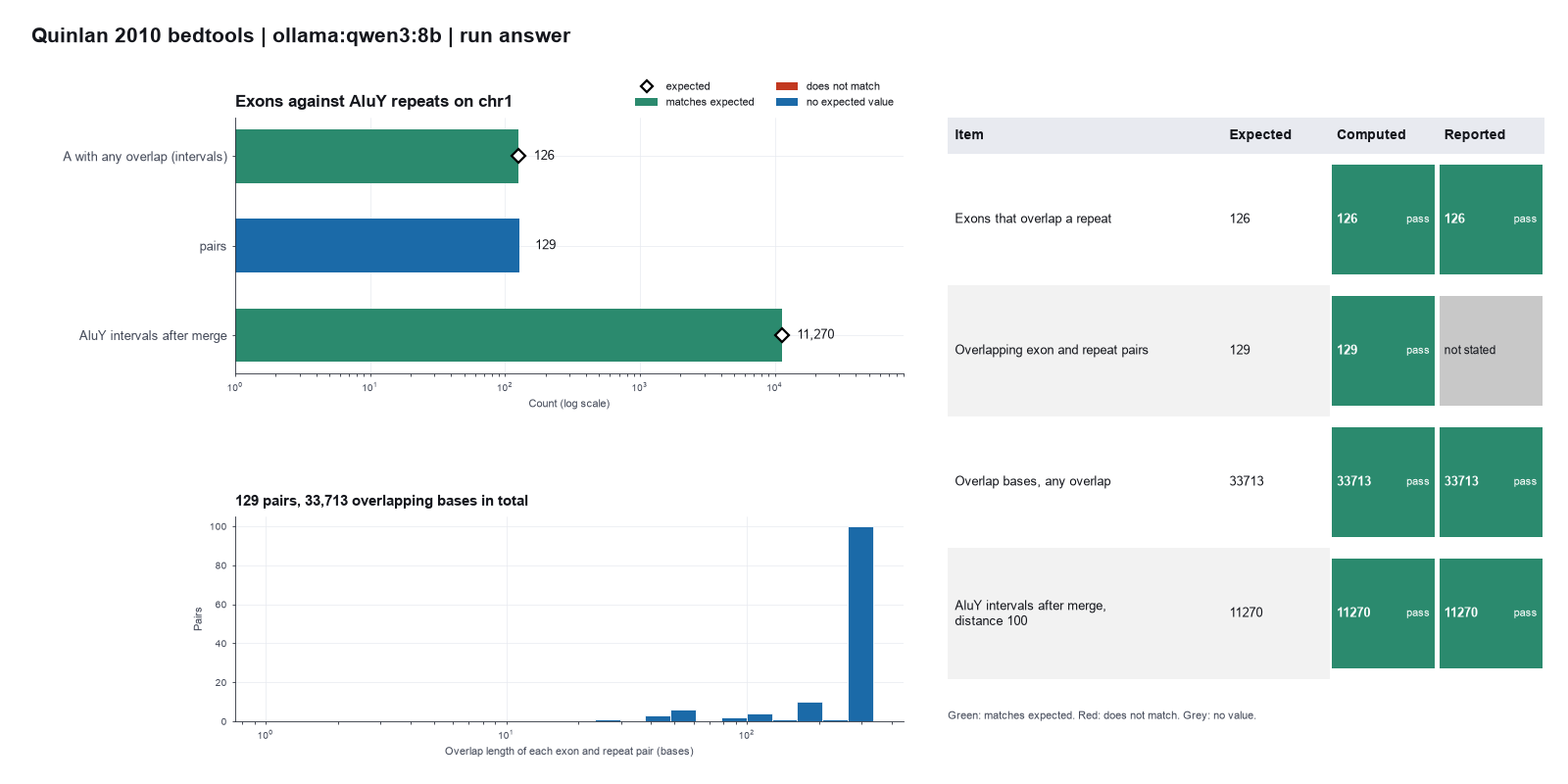
129 lines. 126 A intervals overlap.
Decisions applied: Minimum overlap as a fraction of the exon = 0; Minimum overlap as a fraction of the repeat = 0; Require a reciprocal fraction = false; Strand rule = any.
Input files: {data}/quinlan2010-bedtools/aluY.chr1.bed SHA-256 1d7af795ec35; {data}/quinlan2010-bedtools/refseq.chr1.exons.bed SHA-256 00105bd81f04.
Outputs: bed (fb43e5c485f8).
Arguments
| b | {data}/quinlan2010-bedtools/aluY.chr1.bed |
| min_fraction_a | 0 |
| min_fraction_b | 0 |
| reciprocal | false |
| report | pairs |
| strand | any |
| a | {data}/quinlan2010-bedtools/refseq.chr1.exons.bed |
Tool output
bed={work}/intersect_intervals-1/bed.bed
report=pairs
n_a=43424
n_b=11628
n_result=129
overlap_bases=33713
n_a_with_overlap=126
Model
I found 126 exons overlap a repeat, and the total bases overlapped is 33,713.
Next, I will merge the AluY repeats that lie within 100 bases of each other.
harness note A note from the harness to the model. The scientist did not write it.
- You said what you will do next, but you did not call a tool. Do it now with a tool call, or give your final answer.
merge_intervals (adapter bedtools).step n2 merge_intervals adapter bedtools 0.1.1, bedtools 2.31.1
11628 intervals merged into 11270 (3258788 bases).
Decisions applied: Strand rule = any; Merge distance = 100.
Input file: {data}/quinlan2010-bedtools/aluY.chr1.bed SHA-256 1d7af795ec35.
Outputs: bed (7115318c792f).
Arguments
| distance | 100 |
| path | {data}/quinlan2010-bedtools/aluY.chr1.bed |
| strand | any |
Tool output
bed={work}/merge_intervals-1/bed.bed
n_input=11628
n_merged=11270
merged_bases=3258788
Model The model writes its answer. The claim check reads it. See the final answer.
The final answer
The model wrote this answer. The harness shows it to the scientist after the review.
The AluY repeats were merged, and 11,270 intervals remain after merging.
Final answers:
- 126 exons overlap a repeat, and the total bases overlapped is 33,713.
- 11,270 intervals remain after merging the AluY repeats.
Settings and step results that the answer does not mention. The harness adds them.
Settings used, from the decision record: Smallest overlap as a fraction of A: 0 · Smallest overlap as a fraction of B: 0 · Require the same fraction for A and for B: false · Strand rule: any · Largest gap to merge across: 100.
Checks
Review findings
The review recorded 2 findings. A rule finding comes from a fixed check in the harness. A referee finding comes from a second model that reads the record. The harness shows the findings to the scientist with the final answer. The record does not mark a finding as fixed. Thus a finding from an early review round can apply to a draft that the model corrected later.
| Severity | From | Finding | Shown with the final answer |
|---|---|---|---|
| info | ruletext_style | The answer breaks the text rules (ASD-STE100) in 1 place. Sentence 1 uses the passive voice: "were merged". Use the active voice. | yes |
| info | referee model | The number 11270 is reported as the number of intervals remaining after merging, but the log shows that 11628 intervals were merged into 11270. | yes |
Numbers in the answer
The last claim check read 4 numbers in the answer. 4 numbers match a logged result. 0 numbers have no source in the record.
Deviations
The model did not try to change a choice of the scientist.
Failed tool calls
No tool call failed.
Data integrity
Each data file has the same SHA-256 hash now as at the time of the step that read it. The run did not change the data.
| File | SHA-256 | Fetched data | Steps with this hash |
|---|---|---|---|
{data}/quinlan2010-bedtools/refseq.chr1.exons.bed2.7 MB | 00105bd81f04 | the download script (fetch.sh) has no hash for this file | n1 |
{data}/quinlan2010-bedtools/aluY.chr1.bed410.0 KB | 1d7af795ec35 | the download script (fetch.sh) has no hash for this file | n1, n2 |
A SHA-256 hash is a fingerprint of the file contents. If one byte of the file changes, the hash changes. The table shows the first 12 characters.
How to repeat it
Get the data. The script downloads the files and checks their SHA-256 hashes where it lists them.
CUVETTE_DATA={data} bash bench/papers/quinlan2010-bedtools/fetch.shRun the same case with Cuvette. The script gives the same answers from bench/papers/quinlan2010-bedtools/bench.yaml.
cuvette bench papers --papers quinlan2010-bedtools --models ollama:qwen3:8b
Repeat each step by hand in the program. For each step, the harness records a manual route: the menu path or the code that gives the same result. This list does not include comparison runs.
intersect_intervals(step n1)Run: bedtools intersect -a <A>.bed -b <B>.bed [-f <frac>] [-F <frac>] [-r] [-s | -S] [-wo | -c | -u | -v]
-a
{data}/quinlan2010-bedtools/refseq.chr1.exons.bed-b
{data}/quinlan2010-bedtools/aluY.chr1.bed- -f =
0 - -F =
0 - -r =
false - -s / -S =
any - -wo / -c / -u / -v =
pairs - Warning: If you keep the default 1e-9, you get a different result.
- Warning: If you keep the default 1e-9, you get a different result.
- Warning: If you keep the default , you get a different result.
The manual route that the harness recorded
/bin/sh {other volume}/tools/overnight/checkout/catalog/bedtools/scripts/intersect.sh /opt/homebrew/bin/bedtools {work}/intersect_intervals-1/bed.bed {data}/quinlan2010-bedtools/refseq.chr1.exons.bed {data}/quinlan2010-bedtools/aluY.chr1.bed --fa 0 --fb 0 --reciprocal false --strand any --report pairsThe manual route gives the same numbers. An automatic test in Cuvette checks this.
merge_intervals(step n2)Run: sort -k1,1 -k2,2n <in>.bed | bedtools merge -i - [-d <gap>] [-s]
-i
{data}/quinlan2010-bedtools/aluY.chr1.bed- -d =
100 - -s =
any - Warning: If you keep the default 0, you get a different result.
The manual route that the harness recorded
/bin/sh {other volume}/tools/overnight/checkout/catalog/bedtools/scripts/merge.sh /opt/homebrew/bin/bedtools {work}/merge_intervals-1/bed.bed {data}/quinlan2010-bedtools/aluY.chr1.bed --distance 100 --strand anyThe manual route gives the same numbers. An automatic test in Cuvette checks this.
Figure
Run facts
| Model | qwen3:8b through Ollama, on our own computer |
| Date | 2026-10-09 11:25:52 UTC |
| End of run | the model gave a final answer |
| Time | 44 s |
| Requests to the model | 4 |
| Tokensunits of text that the model read and wrote | 20558 input, 328 output, 0 cache read, 0 cache write |
| Cost estimate | none: the model runs on our own computer |
| Tool calls | 2 (0 failed) |
| Adapters | bedtools 0.1.1, program 2.31.1 |
| Session | 20261009-062552-2171 |
Code hash of each step (2)
| Step | Tool | Program version | Code hash |
|---|---|---|---|
| n1 | intersect_intervals | 2.31.1 | b8bf0e3ce953 |
| n2 | merge_intervals | 2.31.1 | df29e9e2f52d |
The code hash is a fingerprint of the adapter name, the adapter version, the tool and its definition in the adapter. If one of these changes, the hash changes.